Quick Answer
Ferrosilicon 75 (FeSi75) is a high-silicon iron alloy containing about 75% silicon. Published technical references generally place the material density of high-silicon ferrosilicon at around 3.2–3.5 g/cm³, while its melting behavior falls roughly within the 1200–1360°C range depending on the exact composition.
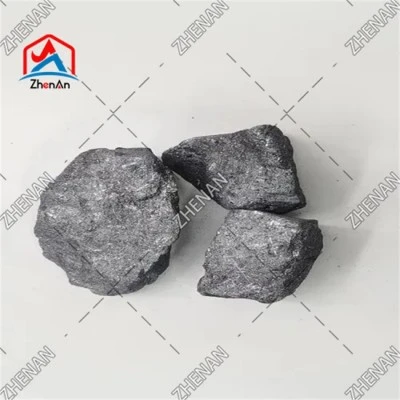
FeSi75 is hard and brittle rather than ductile. It is therefore normally crushed and screened into lumps or granules for steelmaking and foundry use. Particle size affects bulk density, flow, dust generation and how the alloy behaves during feeding, so the physical properties should always be considered together with the actual size specification.
Key Takeaways
- Si content: typically 75% minimum for commercial FeSi75.
- Material density: approximately 3.2–3.5 g/cm³ in published high-silicon FeSi references.
- Melting behavior: approximately 1200–1360°C depending on composition.
- Mechanical behavior: hard and brittle, allowing the alloy to be crushed and screened.
- Bulk density: varies with lump size, particle distribution and packing condition.
- Storage: keep the material dry and control fines during handling.
FeSi75 Physical Properties at a Glance
| Property | Typical Reference |
|---|---|
| Silicon Content | 75% min |
| Material Density | Approx. 3.2–3.5 g/cm³ |
| Bulk Density | Varies with particle size |
| Melting Range | Approx. 1200–1360°C |
| Appearance | Gray to silvery-gray metallic alloy |
| Mechanical Behavior | Hard and brittle |
| Common Lump Sizes | 10–50 mm / 10–100 mm |
The values above are useful for general engineering reference. For an actual order, use the agreed chemical specification, particle size and batch documents rather than relying only on typical physical-property values.
You can check our Ferrosilicon 75 specification for available chemistry, particle sizes, packing and supply information.
What Is the Density of Ferrosilicon 75?
Published references for high-silicon ferrosilicon generally place the material density of FeSi75 at around 3.2–3.5 g/cm³. The actual value changes with silicon content, iron content and other elements in the alloy.
Silicon is less dense than iron, so increasing the silicon proportion generally lowers the density of ferro silicon compared with lower-silicon grades.
Material Density vs Bulk Density
Material density and bulk density are not the same measurement.
Material density describes the solid alloy itself. Bulk density includes the air spaces between individual lumps or granules.
This difference matters when you calculate storage capacity or feeder volume. A tonne of 10–50 mm FeSi75 lumps will not occupy the same volume as a tonne of fine granules or powder.
Bulk density also changes with:
- particle size;
- size distribution;
- amount of fines;
- particle shape;
- packing condition.
If you need to size a hopper, storage bin or automatic feeder, use the bulk density of the actual FeSi75 size you plan to use rather than substituting the solid alloy density.
For more detail on size selection, see our ferrosilicon particle size for steelmaking guide.
What Is the Melting Point of FeSi75?
FeSi75 does not have one exact melting temperature. It is an alloy, so the solidus and liquidus temperatures change with silicon content and impurity levels.
Published data for high-silicon ferrosilicon generally places its melting behavior within roughly 1200–1360°C. You should treat this as a reference range rather than a fixed FeSi75 melting point.
For steelmaking, the alloy is normally introduced into molten metal at temperatures already above this range. The practical concern is therefore not simply whether FeSi75 melts, but how quickly it heats, dissolves and distributes silicon into the bath.
What Affects FeSi75 Dissolution?
Several operating conditions influence how FeSi75 behaves after addition:
- particle size;
- molten steel temperature;
- addition position;
- bath stirring;
- actual alloy composition.
A smaller particle normally heats faster because it has more surface area relative to its mass, but excessive fines can create handling losses and dust. This is why particle-size control matters alongside chemical composition.
If you use the alloy for deoxidation or silicon adjustment, our Ferrosilicon 75 for steelmaking guide covers the application in more detail.
Why Is FeSi75 Hard and Brittle?
FeSi75 behaves very differently from ductile metals. Instead of bending under mechanical force, it tends to fracture into angular pieces.
This brittleness makes it practical to process FeSi75 by crushing and screening. We can therefore prepare controlled lump or granular sizes without machining the material.
The same property also means repeated handling can generate fines. Crushing, loading, unloading and long-distance transport can all change the particle-size distribution if the material is handled aggressively.
If your furnace feeding system has strict requirements, confirm both the main size range and the acceptable amount of fines before placing the order.
How Particle Size Affects FeSi75 Handling
Physical properties become more useful when you connect them with the way FeSi75 is actually stored and fed.
| Factor | Effect |
|---|---|
| Large lumps | Lower surface area and slower heating compared with small particles |
| Fine particles | Heat quickly but generate more dust and handling loss |
| Wide size distribution | Changes bulk packing and feeder behavior |
| Excess fines | Increase dust generation during transfer and charging |
| Controlled size range | Supports more consistent storage, weighing and feeding |
For most orders, chemical composition and particle size should be confirmed together. A correct FeSi75 chemistry with an unsuitable particle size can still create problems during storage or furnace feeding.
FeSi75 Storage and Safety
Keep FeSi75 dry during storage and transport. Clean lump material is normally stable under dry conditions, but fine ferrosilicon dust requires stricter control.
Ferrosilicon safety documentation notes that fine material can react with moisture, acids or alkalis and may generate gases including hydrogen, phosphine and arsine. Fine airborne dust can also create an ignition or explosion risk under suitable conditions.
For routine handling:
- keep bags and storage areas dry;
- avoid unnecessary dust generation;
- provide suitable ventilation where fines can accumulate;
- keep the material away from acids and incompatible chemicals;
- follow the MSDS supplied with your shipment.
Do not use a general physical-property table as a replacement for the applicable MSDS or your site safety procedure.
Which FeSi75 Properties Should You Confirm Before Ordering?
The most useful specification depends on how you plan to use the alloy. Before confirming an order, check:
- Si content and required grade;
- Al, Ca, C, P and S limits if they affect your process;
- particle size for your furnace or feeder;
- fines tolerance if size distribution is important;
- packing for storage and unloading;
- COA and MSDS for batch and safety confirmation.
If FeSi75 already matches your required grade, review our FeSi75 product specification to check chemical composition, available sizes and packing before requesting a quotation.
If you still need to compare different ferro silicon grades, you can also review our ferro silicon grades and products.
Need FeSi75 Specification, COA or MSDS?
Check our available FeSi75 chemistry, particle sizes and packing, or send us your required specification if you need batch documents or a current quotation.
View FeSi75 Specification Request FeSi75 QuoteFeSi75 Physical Properties FAQ
Q: What is the density of Ferrosilicon 75?
A: Published references generally place the material density of high-silicon FeSi75 at around 3.2–3.5 g/cm³. The exact value changes with the actual alloy composition.
Q: Is FeSi75 bulk density the same as material density?
A: No. Material density describes the solid alloy itself. Bulk density includes the spaces between individual particles and changes with particle size, fines and packing condition.
Q: What is the melting point of FeSi75?
A: FeSi75 does not have one exact melting point. Published high-silicon ferrosilicon data generally falls within roughly 1200–1360°C, depending on composition.
Q: Why is FeSi75 brittle?
A: High-silicon ferrosilicon is hard and brittle rather than ductile. It fractures under mechanical force, which allows it to be crushed and screened into different commercial sizes.
Q: Does FeSi75 particle size affect furnace feeding?
A: Yes. Particle size affects bulk packing, feeder behavior, dust generation and heating after addition. Use a size range that matches your storage and feeding system.
Q: Should FeSi75 be stored dry?
A: Yes. Keep FeSi75 dry and follow the applicable MSDS. Fine ferrosilicon can create additional dust and gas hazards when exposed to moisture or incompatible chemicals.
Q: Where can I check the FeSi75 chemical specification?
A: You can review our Ferrosilicon 75 product page for composition, available particle sizes, packing and supply information.
ZHEN AN METALLURGICAL MATERIALS
With 30 years of industry experience, ZHEN AN integrates production, processing and international trade, serving customers in more than 100 countries.
Strong Production Capacity
30,000 m² facilities, two production bases and 150,000+ tons annual capacity, with 5,000 tons of regular ferroalloy inventory.
Quality & Certification
ISO certified, with SGS, BV and Intertek inspection available. COA, MSDS and Certificate of Origin can be provided.
Technical Strength
200+ professionals, 50+ R&D staff and 80+ industrial patents support product development and customization.
24-Hour Export Service
Sample supply, customization, technical selection, logistics and export document support.