


Ferro Alloy
Ferro Alloy Supplier | Ferro Alloy Products for Steelmaking & Metallurgy
Ferro alloys are essential raw materials widely used in steelmaking and metallurgical processes. They play a critical role as deoxidizers, alloying agents, and performance enhancers in the production of high-quality steel and special alloys.
As a professional ferro alloy supplier, ZhenAn provides a wide range of ferro alloy products for global customers. Our products are suitable for steel plants, foundries, and metallurgical industries, ensuring stable quality and reliable performance.
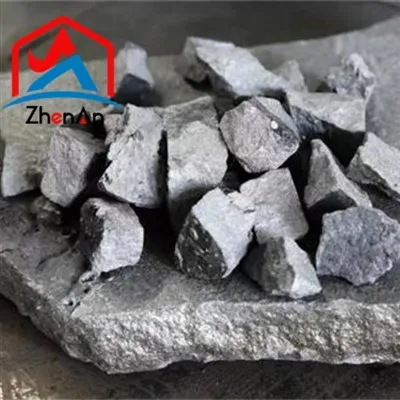


Ferroalloys are alloys of iron and a certain amount of other metal elements and are one of the raw materials for steelmaking. It is used as a deoxidizer and alloying element additive in steelmaking to improve the properties of steel.
Different Types of Ferroalloys
As a steel deoxidizer, the most widely used are ferro manganese and ferro silicon.
Commonly used as alloy additives are ferro manganese, ferro silicon, ferro tungsten, ferro molybdenum, ferro vanadium, ferro titanium, and so on.
Pure metal additives for steelmaking include silicon metal, etc.
Ferrosilicon
Ferrosilicon is an iron alloy composed of iron and silicon. Ferrosilicon is an iron-silicon alloy made from coke, steel chips, and quartz (or silica) as raw materials and smelted in an electric furnace. The main applications of FeSi are in steel production. Ferro Silicon Lumps helps to deoxidize steel and ferrous metals. Further, Ferro Silicon Alloy improves hardness, strength, and corrosion resistance. China is the main producer of Fe Silicon. ZhenAn is a professional Ferro Silicon Lumps, Ferro Silicon Granules, and Ferrosilicon Powder supplier and manufacturer in China with more than 30 years of experience, you can contact us if you want to know the ferrosilicon price.
Ferrovanadium
Ferro Vanadium is usually produced from Vanadium sludge (or titanium-bearing magnetite ore processed to produce pig iron) & available in the range V: 50 – 85%. Ferro Vanadium acts as a universal hardener, strengthener & anti-corrosive additive for steels like High-strength low alloy steel, tool steel, as well as other ferrous-based products.
ZhenAn is a professional Ferro Molybdenum supplier and manufacturer in China, we not only meet the needs of China steel companies, But also export our Ferro Vanadium 50 60 80 to 150 countries and regions including Japan, South Korea, India, Europe, and United States. you can contact us if you want to know the ferrovanadium price.
Ferromanganese
Ferromanganese is an alloy of manganese and iron, which also contains carbon, silicon, phosphorus, and other small amounts of other elements, the main grades of Ferromanganese Alloy are divided according to the carbon content of the alloy, depending on the carbon content of the different for high carbon ferromanganese, medium carbon ferromanganese, low carbon ferromanganese.
ZhenAn is a professional ferro manganese supplier and manufacturer in China with One-Stop Service. We can provide high carbon ferro manganese, low carbon ferro manganese, medium carbon ferro manganese, you can contact us if you want to know the ferro manganese price.
Ferrotitanium
The main component of ferro titanium is an iron alloy of titanium and iron. Ferro Titanium also contains aluminum, silicon, carbon, sulfur, phosphorus, manganese, and other impurities. Ferro Titan is used as a steelmaking deoxidizer, desulphurizer, degassing agent, and alloying agent. According to the different titanium content of the main three varieties: Ferro Titanium 30 (containing Ti 25.0% ~ 35.0%, Al < 8.5%, Si < 5.0%), Ferro Titanium 40 (containing Ti 35.0% ~ 45.0%, Al < 9.5%, Si < 4.0%) and Ferro Titanium 70 (containing Ti 65% ~ 75%, A10.5% ~ 5%, Si < 0.5%).
ZhenAn is a professional Ferro Titanium supplier and manufacturer in China with One-Stop Service. We can provide Ferrotitanium 30, Ferro titanium 40, and Ferrotitanium 70, you can contact us if you want to know the Ferro titanium price.
Examples of Ferroalloys, Composition and Applications
| Grade |
Ferro Silicon Chemical composition |
|||||||
| Si | Al | Ca | Mn | Cr | P | S | C | |
| ≥ | ≤ | |||||||
| FeSi75 | 75 | 1.5 | 1 | 0.5 | 0.5 | 0.04 | 0.02 | 0.2 |
| FeSi72 | 72 | 2 | 1 | 0.5 | 0.5 | 0.04 | 0.02 | 0.2 |
| FeSi70 | 70 | 2 | 1 | 0.6 | 0.5 | 0.04 | 0.02 | 0.2 |
| FeSi65 | 65 | 3.5 | 1 | 0.8 | 0.6 | 0.04 | 0.03 | 0.35 |
| FeSi45 | 40-47 | 2 | 1 | 0.7 | 0.5 | 0.04 | 0.02 | 0.2 |
|
Ferro Vandadium composition (%) |
|||||
|
Grade |
V |
Al |
P |
Si |
C |
|
FeV40-A |
38-45 |
1.5 |
0.09 |
2 |
0.6 |
|
FeV40-B |
38-45 |
2 |
0.15 |
3 |
0.8 |
|
FeV50-A |
48-55 |
1.5 |
0.07 |
2 |
0.4 |
|
FeV50-B |
45-55 |
2 |
0.1 |
2.5 |
0.6 |
|
FeV60-A |
58-65 |
1.5 |
0.06 |
2 |
0.4 |
|
FeV60-B |
58-65 |
2 |
0.1 |
2.5 |
0.6 |
|
FeV80-A |
78-82 |
1.5 |
0.05 |
1.5 |
0.15 |
|
FeV80-B |
78-82 |
2 |
0.06 |
1.5 |
0.2 |
|
Ferro Molybdenum Chemical elements contents % |
|||||||
|
Mo |
Si (Max) |
S (Max) |
P (Max) |
C (Max) |
Cu (Max) |
Sb(Max) |
Sn(Max) |
|
≥70 |
1.5 |
0.10-0.15 |
0.05 |
0.1 |
0.5 |
0.04 |
0.04 |
|
65-70 |
1.5 |
0.10-0.15 |
0.05 |
0.1 |
0.5 |
0.04 |
0.04 |
|
55-65 |
1 |
0.1 |
0.04 |
0.1 |
0.5 |
0.04 |
0.04 |
|
55-65 |
1.5 |
0.1 |
0.05 |
0.1 |
0.5 |
0.05 |
0.06 |
|
55-65 |
2 |
0.15 |
0.05 |
0.2 |
1 |
0.08 |
0.08 |
|
>55 |
2 |
0.1 |
0.05 |
0.15 |
0.5 |
0.04 |
0.04 |
|
>55 |
1 |
0.1 |
0.08 |
0.2 |
0.5 |
0.05 |
0.06 |
|
>55 |
1.5 |
0.15 |
0.08 |
0.25 |
1 |
0.08 |
0.08 |
| Grade |
Ferro Tungsten Chemical composition % |
|||||||||||
| W | C | P | S | Si | Mn | Cu | As | Bi | Pb | Sb | Sn | |
| The following components are not greater than | ||||||||||||
| FeW80-A | 75.0~85.0 | 0.1 | 0.03 | 0.06 | 0.5 | 0.25 | 0.1 | 0.06 | 0.05 | 0.05 | 0.05 | 0.06 |
| FeW80-B | 75.0~85.0 | 0.3 | 0.04 | 0.07 | 0.7 | 0.35 | 0.12 | 0.08 | - | - | 0.05 | 0.08 |
| FeW80-C | 75.0~85.0 | 0.4 | 0.05 | 0.08 | 0.7 | 0.5 | 0.15 | 0.1 | - | - | 0.05 | 0.08 |
| FeW70 | ≥70.0 | 0.8 | 0.06 | 0.1 | 1 | 0.6 | 0.18 | 0.1 | - | - | 0.05 | 0.1 |
|
Ferro titanium specification |
||||||||
|
Grade |
Ti |
Al |
Si |
P |
S |
C |
Cu |
Mn |
|
FeTi30-A |
25-35 |
8 |
4.5 |
0.05 |
0.03 |
0.1 |
0.2 |
2.5 |
|
FeTi30-B |
25-35 |
8.5 |
5 |
0.06 |
0.04 |
0.15 |
0.2 |
2.5 |
|
FeTi40-A |
35-45 |
9 |
3 |
0.03 |
0.03 |
0.1 |
0.4 |
2.5 |
|
FeTi40-B |
35-45 |
9.5 |
4 |
0.04 |
0.04 |
0.15 |
0.4 |
2.5 |
|
FeTi70-A |
65-75 |
3 |
0.5 |
0.04 |
0.03 |
0.1 |
0.2 |
1 |
|
FeTi70-B |
65-75 |
5 |
4 |
0.06 |
0.03 |
0.2 |
0.2 |
1 |
|
FeTi70-C |
65-75 |
7 |
5 |
0.08 |
0.04 |
0.3 |
0.2 |
1 |
WHAT IS FERRO ALLOYS USED FOR?

Deoxidiser.
Ferroalloys are used as deoxidizers to remove oxygen from molten steel during the steelmaking process, and some ferroalloys can also remove other impurities such as sulfur and nitrogen from steel.

Alloy Additives
Ferroalloys are used as alloying additives to add alloying elements to steel to improve the properties of the steel as required by the composition of the steel grade.

Inoculant
Ferroalloys are used as an inoculant added to the iron water before casting to improve the crystalline organization of the casting.

Reducing agent
Ferroalloys are used as reducing agents in the production of other ferroalloys and non-ferrous metals by hot metal reduction and as alloying additives for non-ferrous alloys; they are also used in small quantities in chemical and other industries.

Other uses.
In the metallurgical and chemical industries, ferroalloys are also being used more and more extensively as a medium in ore dressing, as a raw material for the production of certain products and ultrapure substances (elements or compounds), etc.
HOW ARE FERRO ALLOYS MADE?
There are many production methods for ferroalloys, mainly as follows.
1、Classified according to the source of heat
According to different sources of heat, it is divided into carbon heat method, electric heat method, electric silicon heat method and metal heat method.
(1) Carbon thermal method. The carbon thermal method of its smelting process heat source is mainly coke combustion exothermic, with coke as a reductant to reduce the oxides in the ore, production in the blast furnace.
(2) Electrothermal method. The electrothermal method of the smelting process heat source is mainly electric energy, the use of carbonaceous reductant to reduce the oxides in the ore, and the use of continuous operation process, in the reduction of electric furnace.
(3) Electrosilicon heat method. The electro silicon heat method of its smelting process is the main source of heat energy, the rest of the heat released for the oxidation of silicon, the use of silicon (such as ferrosilicon or intermediate products silicomanganese alloys, silicon-chromium alloys) as a reductant to reduce the oxides in the ore, the production of intermittent operations in the refining electric furnace.
(4) Metal heat method. The metal heat method of heat source is mainly from silicon, aluminum, and other metal reductant reduction of concentrates in the oxide when the heat is released, the production of intermittent, in the cylinder smelting furnace.
2, according to the operation method and process classification
The different characteristics of the production process are divided into flux method and no flux method, continuous and intermittent, no slag method, and slag method and other smelting methods.
(1) Melt method. The production of ferroalloys by the flux method uses carbonaceous materials, silicon, or other metals as reductants and slagging materials are added to regulate the composition and nature of the slag (acidity and alkalinity of the slag).
(2) Non-flux method. The production of ferroalloys without flux method generally uses carbonaceous materials as reductants, and no slagging materials are added to regulate the composition and nature of slag during production.
(3) Continuous smelting method. The continuous smelting method, on the one hand, is according to the falling of the material surface of the furnace mouth, and continuously adding material to the furnace, on the other hand, the alloy and slag accumulated in the melting pool of the furnace are regularly excluded. With submerged arc reduction smelting, the operating power is almost balanced and stable.
(4) Intermittent smelting method. The intermittent smelting method is to concentrate batches of charge added to the furnace, The smelting process is generally divided into two periods of melting and refining, the melting electrode is buried in the charge, refining is completed, discharged alloy and slag, and then loaded with new material for the next furnace smelting. Due to the different process characteristics of each period of smelting, the operating power is also different.
(5) Slagless method. Smelting of ferroalloys by slagless method uses carbonaceous reductant, silica, or remanufactured alloy as raw materials, and is smelted continuously in the reduction electric furnace.
(6) Slag method. Slag method smelting of ferroalloys is in the reduction furnace or refining furnace, the choice of reasonable slagging system to produce ferroalloys, the slag-iron ratio is affected by smelting varieties and raw materials used in the conditions, and other factors.
How are Ferro Alloys Transported and Stored
Transporting and storing ferro alloys can be challenging due to their high weight, bulkiness, and sensitivity to moisture and oxidation. Therefore, proper care and precautions are needed to ensure the quality and safety of these products. Here are some tips on how to transport and store ferro alloys


- Use Suitable Containers
- Ferroalloys should be packed in strong and durable containers that can withstand the weight and pressure of the products. The containers should also be sealed and waterproof to prevent moisture from entering and causing rust or corrosion. Some common types of containers used for ferro alloys are steel drums, big bags, wooden crates, etc.
- Handle With Care
- Ferroalloys should be handled with care during loading and unloading to avoid damage or spillage. The containers should be lifted by cranes or forklifts and placed securely on trucks or ships. The containers should not be dropped, dragged, or stacked too high to prevent deformation or breakage.
- Choose Appropriate Transport Modes
- Ferroalloys can be transported by road, rail, sea, or air depending on the distance, cost, and availability of the transport modes. However, some factors should be considered when choosing the transport mode, such as the weather conditions, the transit time, the security measures, etc. For example, sea transport may expose the ferroalloys to humidity and salt water, which can affect their quality. Therefore, adequate protection and ventilation should be provided during sea transport.
- Store in Dry and Ventilated Places
- Ferroalloys should be stored in dry and ventilated places away from direct sunlight, heat sources, or flammable materials. The storage areas should also be clean and free of dust, dirt, or moisture that can contaminate the products. The containers should be arranged in an orderly manner with enough space between them to allow air circulation and easy access. The storage areas should also be monitored regularly for any signs of damage or deterioration of the products.
Our Cooperative Partner


Frequently Asked Questions About Ferro Alloy