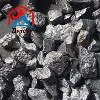
Ferrosilicon particle size affects how the alloy is handled, charged, heated and assimilated during steelmaking. This guide explains how to compare common FeSi lump sizes, why fines and oversize matter, and what to check when selecting a particle-size specification for your process.
Quick Answer
There is no single ferrosilicon particle size that is best for every steelmaking process. 10–50 mm is a common lump size, while 10–100 mm and other screened ranges may also be used depending on the charging system, available assimilation time and handling requirements.
Smaller particles provide more surface area for heating and contact with molten steel, but excessive fines can create more dust and handling loss. Larger lumps require sufficient time and suitable conditions for heating and assimilation.
For this reason, the nominal size on a purchase specification is only part of the decision. When particle-size control matters to your process, also check the amount of fines, oversize material and the consistency of the delivered size distribution.
Why Does Ferrosilicon Particle Size Matter in Steelmaking?
Ferrosilicon is added to molten steel as a source of silicon for deoxidation and alloy adjustment. Once it enters the melt, the alloy must be heated, interact with the liquid steel and become assimilated into the bath.
Particle size affects this process because it changes the surface area, mass and characteristic heating distance of each piece.
However, particle size does not work independently. Melt temperature, bath movement, addition position, FeSi grade and the way the alloy enters the steel can also influence its behavior. A particle-size specification should therefore be considered as one part of the overall addition practice rather than as a single predictor of metallurgical performance.
Heating and Dissolution
For the same mass of material, smaller pieces have a higher total external surface area than a few large lumps.
This generally gives the surrounding melt more surface area for heat transfer and contact with the ferrosilicon, while reducing the distance over which heat must penetrate an individual piece.
That does not mean that the smallest possible particle is automatically the best choice. Very fine material introduces different handling and charging problems, while larger particles may perform adequately when the process provides sufficient contact and assimilation time.
The practical question is therefore not simply which particle size heats fastest, but which size range provides suitable heating, assimilation and handling behavior under the actual steelmaking conditions.
Handling and Charging
Particle size also determines how the material behaves before it reaches the molten steel.
A suitable specification should be compatible with storage bins, hoppers, chutes, conveying equipment, weighing systems and the actual alloy addition point.
A wider particle-size range can contain both relatively small particles and much larger lumps. This may be acceptable in a simple bulk-addition system, while a more controlled feeding system may benefit from tighter size consistency.
Fines and Dust
Fines should not be treated as an insignificant part of the specification.
Very small particles are more easily dispersed during loading, conveying and charging. Depending on the handling system, this can increase dust generation and material loss before the full quantity reaches the intended addition point.
Fines can also separate from larger lumps during repeated transport and vibration. For operations that require consistent charging behavior, the percentage of material below the specified lower size limit can therefore matter as much as the nominal size itself.
Common Ferrosilicon Particle Sizes for Steelmaking
Ferrosilicon can be crushed and screened into different commercial size ranges after solidification. The available range depends on the required grade, product form and supply specification.
| Particle Size | General Form | Main Selection Consideration |
|---|---|---|
| Below 10 mm | Fine or small granules | Greater surface area, but dust and handling require more attention |
| 10–50 mm | Medium lumps | Relatively controlled lump range for many alloy-addition operations |
| 10–100 mm | Wider lump range | Allows larger pieces and a broader particle distribution |
| Other Screened Sizes | Specified lump or granular form | Selected according to equipment and process requirements |
These ranges should be treated as commercial size categories rather than universal steelmaking standards. A plant should not select 10–50 mm simply because another steelmaker uses the same range.
You can also compare our available ferrosilicon grades and forms when matching particle size with the required FeSi chemistry and product form.
Why Is 10–50 mm Ferrosilicon Common in Steelmaking?
The 10–50 mm range is commonly supplied as a ferrosilicon lump specification because it keeps the material within a relatively controlled range without reducing it to predominantly fine material.
Its practical value comes from the combination of a defined lower limit and a moderate upper lump size.
More Controlled Maximum Lump Size
Compared with a 10–100 mm specification, the largest nominal pieces in a 10–50 mm lot are smaller.
This can be useful where excessively large lumps are undesirable because of charging-equipment dimensions or limited time for heating and assimilation.
Narrower Nominal Size Range
A 10–50 mm specification also has a narrower nominal range than 10–100 mm.
This does not guarantee that every delivered piece will be identical, but a properly screened batch can provide a more controlled feed size when consistent lump dimensions are preferred.
Practical for Many Alloy Addition Systems
Medium-sized lumps can be convenient for bulk handling because they avoid both very large pieces and a predominantly fine product.
However, 10–50 mm should be considered a common option rather than a universal optimum. If a plant already operates successfully with another particle range, changing the specification should be based on process requirements rather than on the assumption that one commercial size is inherently better.

10–50 mm vs 10–100 mm Ferrosilicon
The difference between 10–50 mm and 10–100 mm ferrosilicon is not simply that one specification is better than the other.
The main difference is the permitted particle-size range and therefore the potential variation in lump size within the shipment.
| Factor | 10–50 mm FeSi | 10–100 mm FeSi |
|---|---|---|
| Nominal Range | Narrower | Wider |
| Maximum Nominal Lump Size | 50 mm | 100 mm |
| Particle Uniformity | Potentially more controlled when properly screened | Greater variation between smaller and larger lumps |
| Heating Consideration | Smaller maximum size can reduce variation between individual pieces | Larger pieces require suitable heating and assimilation conditions |
| Handling | Useful where tighter lump-size control is preferred | Suitable where a wider lump range is acceptable |
| Key Purchase Check | Fines and oversize percentage | Large-lump distribution, fines and oversize percentage |
When Does 10–50 mm Make More Sense?
A tighter 10–50 mm range may be preferable when the charging equipment has a limited opening, very large lumps are undesirable, more consistent feed size is required, or the plant wants tighter control over the upper particle limit.
When Can 10–100 mm Be Acceptable?
A 10–100 mm specification may be suitable when the charging system can handle larger lumps, a broader particle distribution does not interfere with feeding, and the process provides adequate conditions for larger pieces to heat and become assimilated.
The correct decision therefore comes from the process rather than from the size label alone.
What Happens If Ferrosilicon Is Too Fine?
Fine ferrosilicon is not automatically unsuitable. Some processes intentionally require smaller particles.
The concern appears when a lump specification contains more fines than the handling or charging system expects.
More Dust During Handling
Smaller particles are more easily displaced by air movement during transfer, weighing and charging.
This can increase workplace dust and the amount of material captured by dust-control systems rather than entering the intended process stream.
Greater Risk of Handling Loss
Fines can be lost at transfer points or remain in conveying and collection equipment.
When particle-size control is important, the amount of fine material should therefore be considered when comparing different shipments.
Particle Segregation
Repeated vibration during transportation can cause fine and coarse fractions to redistribute within bulk material.
If material is withdrawn unevenly, one portion of the shipment may contain more fines while another contains more coarse lumps. This is one reason that a consistent particle-size distribution can be valuable for repeatable charging.
What Happens If Ferrosilicon Is Too Coarse?
Large ferrosilicon lumps create a different set of considerations.
A larger particle contains more mass but has less external surface area relative to its volume than smaller pieces. It therefore requires suitable heating and contact with the liquid steel before it becomes fully assimilated.
This deserves more attention when:
- alloy addition occurs late in the process,
- the available mixing or holding time is short,
- the addition point provides limited contact with the bath,
- or the feeding equipment cannot handle large pieces reliably.
Large lumps are not necessarily poor-quality material. They simply need to match the operating and charging conditions.
How Does Particle Size Affect Ferrosilicon Dissolution?
Particle size changes the physical conditions under which an individual FeSi piece heats and interacts with molten steel.
For a given mass, breaking the material into smaller pieces increases the total external surface area. This increases the area available for heat transfer and contact with the liquid phase.
However, actual assimilation also depends on factors such as:
- molten steel temperature,
- bath stirring and movement,
- addition position,
- immersion behavior,
- FeSi grade and composition,
- slag contact,
- and the time available before the next process step.
For this reason, particle size alone should not be used to predict a specific recovery percentage or dissolution time.

How to Match Ferrosilicon Size to the Charging Method
A useful way to select FeSi particle size is to begin with the addition system rather than beginning with a size number.
Bulk Charging
For conventional bulk addition, check the maximum acceptable lump size, charging opening, transfer and chute dimensions, available assimilation time and the amount added per batch.
A relatively wide lump specification may be acceptable if the equipment and process can handle the complete size range.
Hopper or Chute Feeding
When ferrosilicon passes through a controlled hopper or chute, particle-size consistency can become more important.
Check whether large pieces can restrict material flow and whether excessive fines affect feeding behavior. In this situation, controlling both the upper size and the actual size distribution may be more useful than specifying only a broad nominal range.
Fine or Granular Addition
When a process intentionally uses smaller particles, handling becomes a larger part of the specification.
Dust collection, transfer loss, segregation and feeding consistency should all be considered together with the way the material enters the molten bath.
Select ferrosilicon size according to the charging system and operating conditions rather than choosing a particle size only because it is common in the market.
How Is Ferrosilicon Particle Size Controlled?
Commercial ferrosilicon lump size is obtained after the molten alloy has been produced, cooled and solidified. The material can then be broken and screened to obtain the required commercial size range.
This means that particle size is a physical supply specification separate from chemical grade. FeSi75 and FeSi72, for example, describe chemical grades, while 10–50 mm or 10–100 mm describe the physical size of the supplied material.
If you want to understand where crushing and size preparation fit into the wider manufacturing route, see our overview of ferrosilicon production and processing.
Screening quality matters because the nominal size range is only useful when the delivered material remains reasonably consistent with the agreed specification.
Nominal Size vs Actual Particle Size Distribution
A 10–50 mm specification does not necessarily mean that every piece in a shipment falls perfectly within the 10–50 mm range.
The nominal size describes the intended commercial range, but it does not by itself show how particles are distributed within that range or how much material falls below or above the stated limits.
For example, two shipments could both be quoted as:
FeSi75, 10–50 mm
but still differ in:
- fine fraction,
- oversize fraction,
- concentration of particles near the lower limit,
- concentration of particles near the upper limit,
- screening consistency,
- and breakage generated during transport.
Those differences can matter when the charging system is sensitive to particle size.
| Parameter | Why It Matters |
|---|---|
| Nominal Size | Defines the intended commercial particle range |
| Fines | Shows how much material falls below the lower size limit |
| Oversize | Shows how much material exceeds the upper size limit |
| Particle Distribution | Shows where most of the material actually falls within the range |
| Screening Consistency | Influences physical uniformity between lots |
| Batch Consistency | Helps maintain similar handling and charging behavior between deliveries |
Therefore, if your process has strict particle-size requirements, "10–50 mm" alone may not be a complete purchasing specification. Acceptable fines and oversize limits should also be agreed when they are important to the operation.
What Should You Specify When Ordering Ferrosilicon?
A practical ferrosilicon inquiry should identify both the required chemical grade and physical form.
Instead of sending only:
FeSi75, 10–50 mm
you can provide the following information:
| Item | What to Confirm |
|---|---|
| FeSi Grade | FeSi75, FeSi72, FeSi65 or required chemistry |
| Silicon Content | Required Si range according to the purchasing specification |
| Particle Size | For example 10–50 mm or another required range |
| Fines Limit | Maximum acceptable material below the lower size limit, when required |
| Oversize Limit | Maximum acceptable material above the upper size limit, when required |
| Quantity | Required order quantity |
| Packing | Required packing or handling format |
| Application | Steelmaking use or relevant charging information when size selection needs to be checked |
Chemical composition should still be evaluated together with particle size. A 10–50 mm material is not a complete specification unless the required FeSi grade and relevant impurity limits are also defined.
How to Choose the Right Ferrosilicon Particle Size
Step 1: Confirm the Ferrosilicon Grade
First determine whether the process requires FeSi75, FeSi72, FeSi65 or another composition. Particle size does not replace the chemical specification.
Step 2: Check the Charging Equipment
Confirm the opening dimensions, hopper or chute limitations, conveying method and whether the system can accept larger lumps.
Step 3: Consider the Available Process Time
Consider how much time is available for the alloy to heat, interact with the bath and become assimilated before the next process stage.
Step 4: Select the Nominal Size Range
Choose a commercial size that fits both the equipment and the operating conditions. For many applications this may be 10–50 mm, but another range can be appropriate when process requirements differ.
Step 5: Define Fines and Oversize Where Necessary
If particle-size consistency affects feeding or process control, specify acceptable material below and above the nominal range.
Step 6: Compare Actual Production Performance
If an existing FeSi size already provides stable feeding and metallurgical performance, your own production records are more useful than a general claim that another commercial particle size is universally better.
Key Takeaways
- There is no universal best ferrosilicon particle size for every steelmaking operation.
- 10–50 mm is a common commercial lump range, while 10–100 mm and other screened specifications may also be suitable.
- Smaller particles provide more external surface area, but excessive fines can create dust, segregation and handling loss.
- Larger particles require suitable charging conditions and sufficient time for heating and assimilation.
- When size consistency matters, buyers should evaluate fines, oversize and actual particle-size distribution rather than relying only on the nominal size label.
FAQ About Ferrosilicon Particle Size
What particle size of ferrosilicon is commonly used in steelmaking?
10–50 mm is one commonly supplied lump range for steelmaking. However, 10–100 mm and other screened sizes can also be used. The suitable range depends on the charging equipment, addition method and process conditions rather than on a universal steelmaking standard.
Is 10–50 mm ferrosilicon suitable for steelmaking?
Yes, 10–50 mm is a practical commercial lump range for many steelmaking applications. Its controlled upper particle size can be useful for handling and charging, but suitability should still be checked against the plant's actual equipment and operating conditions.
What is the difference between 10–50 mm and 10–100 mm ferrosilicon?
The main difference is the particle-size range. A 10–50 mm specification limits the nominal upper size to 50 mm, while 10–100 mm allows larger lumps and a wider size distribution. Neither range is automatically better; the choice depends on how the material will be handled and added.
Does smaller ferrosilicon dissolve faster?
Reducing particle size increases external surface area relative to material volume and reduces the heating distance within each piece. However, actual assimilation also depends on molten steel temperature, mixing, addition position, FeSi composition and other process conditions. Smaller particles therefore do not automatically provide better overall performance.
Should fines and oversize limits be included in a ferrosilicon specification?
They are worth defining when particle-size consistency matters to the charging system or process. A nominal 10–50 mm specification alone does not show how much material may fall below or above that range.
Need to Confirm Your Ferrosilicon Particle Size?
If you already know the required FeSi grade and particle size, send us your specification for confirmation.
If you are comparing 10–50 mm, 10–100 mm or another screened range, provide your FeSi grade, required size, quantity and any specific fines or oversize limits. These details make it easier to compare the available material with your purchasing requirements.