Quick Answer
A Ferrosilicon 75 COA confirms the actual chemical composition of a specific FeSi75 batch. Before accepting a shipment, check that the COA matches your order number or batch number and compare the reported Si, Al, C, S and P values with the specification agreed before purchase.
A COA is different from an ISO certificate, MSDS or third-party inspection report. The COA confirms batch chemistry, while the other documents cover quality systems, safety, origin or independent inspection. If your order requires SGS, BV or Intertek inspection, confirm this before shipment so sampling and testing can be arranged against the same FeSi75 specification.
Key Takeaways
- A FeSi75 COA should be linked to a specific batch or lot.
- Check actual Si, Al, C, S and P results against your agreed specification.
- Do not treat a generic specification sheet as a batch COA.
- ISO certification confirms the quality-management system, not the chemistry of one shipment.
- SGS, BV or Intertek inspection can be arranged when independent verification is required.
- Keep the COA together with your order specification, packing list and other shipment documents.
What Is a Ferrosilicon 75 COA?
COA stands for Certificate of Analysis. For FeSi75, it records the test results obtained from a defined production batch or lot.
The most important difference between a COA and a general product specification is simple: the specification tells you what the material is required to meet, while the COA tells you what was measured for the batch supplied.
For example, your order may require FeSi75 with Si ≥75%, Al ≤2%, C ≤0.2%, S ≤0.02% and P ≤0.04%. The COA should then show the actual test values for that batch so you can compare them directly with the agreed limits.
You can review our Ferrosilicon 75 specification for available composition, particle sizes and packing.
What Should a Ferrosilicon 75 COA Show?
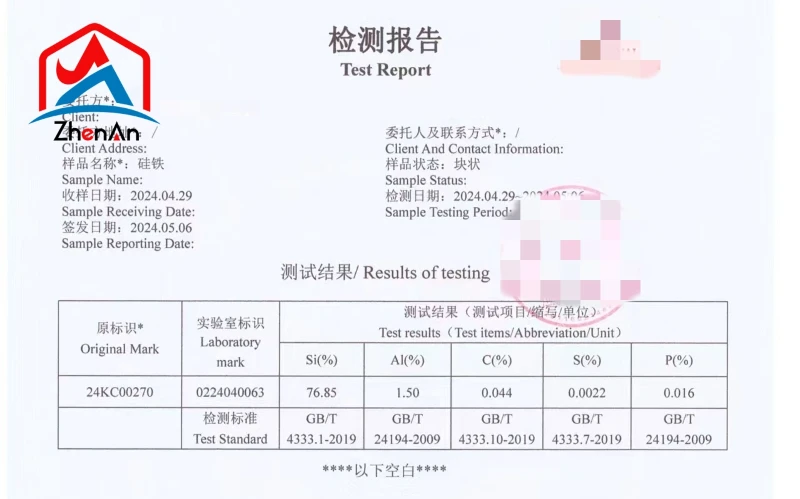
A useful FeSi75 COA should make the batch easy to identify and the test results easy to verify.
| COA Item | What to Check |
|---|---|
| Product / Grade | Ferrosilicon 75 / FeSi75 |
| Batch or Lot Number | Should match the material supplied and related shipment records |
| Silicon (Si) | Check the actual result against the minimum Si requirement |
| Aluminum (Al) | Check against the maximum limit agreed for your order |
| Carbon (C) | Confirm the result is within your specification |
| Sulfur (S) | Confirm the reported value is below the agreed maximum |
| Phosphorus (P) | Confirm the reported value is below the agreed maximum |
| Test Date | Shows when the batch was analyzed |
| Test Method / Standard | Confirm the analytical method or agreed testing basis |
| Issuer / Laboratory | Identifies where the analysis was carried out |
Depending on the order, the COA may also include Ca, Mn, Cr or other elements. If one of these elements matters to your steelmaking or foundry process, add the required limit to the purchase specification before ordering rather than checking it only after production.
How to Read a FeSi75 COA
1. Match the COA to the Correct Batch
Start with the grade, batch number and lot information. A chemical analysis has little value if you cannot connect it to the material delivered.
The batch or lot number on the COA should correspond with your order records and, where applicable, the packing or inspection documents supplied with the shipment.
2. Check Silicon Content First
FeSi75 is identified by its high silicon content, but do not rely only on the words "FeSi75" at the top of the report. Read the actual Si result.
If your contract requires Si ≥75%, the reported batch result should meet that requirement. If your purchasing specification uses a different range, compare the COA with that agreed range instead.
3. Check the Impurity Limits
After Si, check Al, C, S and P against your order specification.
These limits should be confirmed before quotation because different steel grades and production processes may require different impurity control. A batch that meets a general FeSi75 grade may still be unsuitable if your process requires lower aluminum or tighter phosphorus control.
4. Look for Actual Test Results
A COA should show measured results, not simply repeat the maximum and minimum limits from a product specification.
For example:
| Element | Order Requirement | Example COA Format |
|---|---|---|
| Si | ≥75% | Actual tested value |
| Al | ≤2.0% | Actual tested value |
| C | ≤0.2% | Actual tested value |
| S | ≤0.02% | Actual tested value |
| P | ≤0.04% | Actual tested value |
The figures above show our standard FeSi75 reference limits, not a sample batch result. Actual COA values must come from the tested production batch.
COA vs MTC, Inspection Report and ISO Certificate
These documents are related, but they do not serve the same purpose.
| Document | Main Purpose |
|---|---|
| COA | Shows the analyzed chemical composition of a specific batch or lot |
| MTC / Mill Test Certificate | May combine batch test results with product and traceability information, depending on the supplier and contract |
| SGS / BV / Intertek Report | Provides independent inspection or testing when required before shipment |
| ISO Certificate | Confirms the certified quality-management system; it does not replace a batch COA |
| MSDS | Provides handling, storage and safety information |
| Certificate of Origin | Confirms the declared country of origin for trade and customs documentation |
If your contract, internal quality system or letter of credit requires independent inspection, tell us before production or loading. We can coordinate SGS, BV or Intertek inspection according to the agreed scope.
Does Particle Size Appear on the FeSi75 COA?
Not always. A COA primarily records chemical analysis. Particle size may appear on the same document, but it can also be confirmed through the product specification, inspection report or packing documents.
For FeSi75 lumps, common order sizes include 10–50 mm and 10–100 mm. If fines or oversize limits are important to your feeding system, write those requirements into the purchase specification before production.
You can also review our ferrosilicon particle size guide for more detail on size selection and furnace feeding.
How to Confirm FeSi75 Before Shipment
For a normal order, we recommend confirming the specification and inspection method before production rather than waiting until the material is ready to ship.
A practical sequence is:
- Confirm the FeSi75 chemical specification.
- Confirm particle size and packing.
- Agree on the required COA fields.
- Confirm whether factory inspection or third-party inspection is required.
- Complete sampling and testing for the production batch.
- Review the COA before shipment.
- Keep the final COA with the commercial and shipping documents.
If independent inspection is required, the sampling plan should also be agreed in advance. This avoids disputes over whether the tested sample represents the actual shipment.
Common FeSi75 COA Problems to Check
Before you approve the documents, check for a few simple problems:
- No batch reference: you cannot clearly connect the test report with the shipment.
- Specification limits instead of results: the document only repeats "Si ≥75%" instead of reporting the actual measured value.
- Wrong grade: the COA does not match the FeSi75 grade stated in your purchase order.
- Missing required element: an impurity that matters to your process is not reported.
- Unclear test information: the document does not identify the test date, method or issuer clearly enough for your acceptance procedure.
- Mismatch with other documents: the batch or product information differs from the packing or inspection records.
The easiest way to avoid these problems is to agree on the required specification and documentation before the order is confirmed.
FeSi75 COA and Steelmaking Quality Control
If you use FeSi75 for steel deoxidation or silicon adjustment, the COA helps you calculate additions from the actual chemistry rather than from the grade name alone.
A change in Si content changes the silicon units introduced into the melt, while Al, C, P and S may affect your process limits. This is why we recommend keeping the batch COA with your furnace or incoming-material records.
For application details, see our Ferrosilicon 75 for steelmaking guide.
Our FeSi75 Quality and Document Support
We have more than 30 years of experience in metallurgical materials and integrate production, processing and international trade. Our production facilities cover approximately 30,000 m², with two production bases and a testing laboratory.
| Annual Capacity | 150,000+ tons |
| Regular Ferroalloy Stock | About 5,000 tons |
| Professional Team | 200+ staff, including 50+ R&D personnel |
| Industrial Patents | 80+ |
| Export Markets | 100+ countries |
| Quality Support | ISO certified; SGS, BV and Intertek inspection available |
For FeSi75 orders, we can provide batch COA, MSDS, Certificate of Origin and the export documents agreed for your shipment. Third-party inspection can also be arranged before shipment when required.
If you already know the grade, size and impurity limits you need, check our FeSi75 product specification or send us your purchasing specification directly.
Need a FeSi75 COA or Third-Party Inspection?
Send us your FeSi75 chemistry, particle size, quantity, inspection requirements and destination port. We can confirm the available specification, COA documents and current quotation.
Check FeSi75 Specification Request Sample COA & QuoteFerrosilicon 75 COA FAQ
Q: What should a Ferrosilicon 75 COA contain?
A: A useful FeSi75 COA should identify the grade and batch or lot and report the actual chemical analysis. Si, Al, C, S and P are commonly checked, while other elements can be added according to your purchase specification.
Q: Is a FeSi75 COA the same as a product specification?
A: No. The specification defines the required limits for the order. The COA reports the actual measured chemistry of a specific production batch.
Q: Is a COA the same as an MTC?
A: Not always. The terms may overlap in commercial use, but an MTC can contain broader product and traceability information. Confirm the exact document and fields required in your purchase contract.
Q: Does ISO certification replace a FeSi75 COA?
A: No. ISO certification relates to the quality-management system. You still need batch test results when your order requires a FeSi75 COA.
Q: Can you arrange SGS, BV or Intertek inspection for FeSi75?
A: Yes. We can coordinate third-party inspection according to your agreed inspection scope. Confirm the agency and testing requirements before shipment.
Q: Does a FeSi75 COA include particle size?
A: It may, but not every COA includes physical sizing. Particle size can also be confirmed in the purchase specification or inspection report. If size and fines limits are important, include them in your order requirements.
Q: Can you provide a sample FeSi75 COA before I place an order?
A: Yes. Contact us with your required FeSi75 grade and application, and we can discuss the available specification, documentation and sample COA format.

ZHEN AN METALLURGICAL MATERIALS
With 30 years of industry experience, ZHEN AN integrates metallurgical material production, processing and international trade.
We operate two production bases and a testing laboratory, with 150,000+ tons annual capacity and service coverage in more than 100 countries.
Production Capacity
Quality Control
Technical Strength
Export Service
Production Capacity
30,000 m² facilities, two production bases, 150,000+ tons annual capacity and about 5,000 tons of regular ferroalloy stock.
Quality & Certification
ISO certified, with SGS, BV and Intertek inspection available. COA, MSDS and Certificate of Origin can be provided.
Technical Strength
200+ professionals, 50+ R&D staff and 80+ industrial patents support product development and customization.
24-Hour Export Service
Samples, customization, technical selection, logistics coordination and export document support.