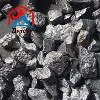
What Ferrosilicon Alloy Actually Is
Ferrosilicon is a master alloy of iron and silicon smelted in submerged arc furnaces from quartz, carbon reductants and iron-bearing charge. Commercial material is graded by silicon content, and the grades that dominate steelworks and foundries are FeSi75 and FeSi65, with FeSi72 specified where a tighter silicon band is needed for predictable recovery. The elements that decide how a heat behaves in the ladle are aluminium, carbon, sulphur and phosphorus: aluminium controls slag volume and reaction speed, while sulphur and phosphorus must stay low in grades feeding clean steel and ductile iron.
Because silicon has a very high affinity for oxygen, ferrosilicon is consumed in far larger tonnages than its unit price suggests. It works as a deoxidiser, an alloying carrier, a graphite promoter in cast iron, a reducing agent in ferroalloy smelting and, in ground form, as a dense-medium suspension and a welding consumable additive.
Deoxidation and Alloying in Steelmaking
In ordinary carbon and low-alloy steelmaking, ferrosilicon is added for precipitation deoxidation and diffusion deoxidation. Precipitation deoxidation takes place in the ladle, where silicon combines with dissolved oxygen and the resulting silica rises into the slag. Diffusion deoxidation is applied to steels that must be very low in oxygen, where a reducing slag is maintained and silicon is fed to drive oxygen out of the metal bath.
Silicon is also a deliberate alloying element. Additions raise strength, hardness and elastic response, and in electrical steels silicon increases permeability and resistivity, which lowers eddy-current and hysteresis losses in transformer cores. That is why silicon-bearing electrical steel is the standard material for laminated cores rather than plain low-carbon sheet.
Ladle deoxidation: added after aluminium or in combination with it, with recovery influenced by slag basicity and temperature.
Alloying: used to reach a target silicon range in spring, tool and electrical steels.
Reducing agent: consumed in the smelting of low-carbon ferroalloys, where it reduces oxides in the charge.
Inoculation of Ductile and Grey Iron
When ferrosilicon is added to molten cast iron shortly before pouring, it acts as an inoculant. Inoculation prevents the formation of hard carbides, promotes the precipitation and spheroidisation of graphite, and reduces chill depth at thin sections. The result is a cast iron that machines cleanly, resists cracking and shows more uniform hardness across wall thickness.
Inoculant grades are not the same as bulk deoxidation grades. They are usually produced with a controlled aluminium and calcium content and in a closely sized fraction, because dissolution kinetics and nucleation behaviour depend strongly on particle size. A typical foundry practice uses a sized fraction matched to pouring weight, with a small addition made in the stream or in the mould for late inoculation.
Ground Ferrosilicon: Dense Media and Welding
Finely milled, lower-silicon ferrosilicon is the standard heavy-medium solid for dense medium separation circuits in coal washing and mineral processing. Suspended in water it produces a stable medium whose effective density can be trimmed to the cut point of the separator, so light and heavy particles report to different products. For this duty the powder is specified by particle size distribution, apparent density and magnetic susceptibility, since all three affect medium stability and recovery losses.
In welding consumable manufacturing, ferrosilicon powder is used in electrode coating formulations and in flux-cored wire fills as a deoxidiser and slag former. It protects the weld pool from oxygen pickup and helps control bead shape and slag detachability. Here again the specification focuses on chemistry, loss on ignition and screen analysis rather than on lump size.
Typical Specification Ranges
| Grade | Si (%) | Al (%) max | C (%) max | S (%) max | P (%) max |
|---|---|---|---|---|---|
| FeSi75 | 72.0 - 80.0 | 1.5 - 3.0 by grade | 0.20 | 0.02 | 0.04 |
| FeSi72 | 70.0 - 76.0 | 1.5 - 2.0 | 0.20 | 0.02 | 0.04 |
| FeSi65 | 63.0 - 68.0 | 2.0 | 0.20 | 0.02 | 0.04 |
Grade names, chemical limits and sampling rules are set out in GB/T 2272 for ferrosilicon; buyers should always confirm the edition in force and ask for a lot-specific certificate rather than relying on a generic range.
Lump: 10 - 60 mm and 50 - 100 mm, used for furnace and ladle additions.
Granule: 3 - 10 mm and 0.5 - 3 mm, used for inoculation and continuous feeding.
Powder: 0 - 3 mm, 0 - 1 mm and finer milled fractions for dense media and coating work.
Packing: 1000 kg or 1250 kg jumbo bags, 25 kg or 50 kg bags and steel drums for powder.
Selection and Handling Notes
Two practical points decide whether a purchase performs as expected. First, match size to the addition method: oversize lumps dissolve too slowly in a small ladle, while excessive fines oxidise on the bath surface and cut recovery. Second, keep the moisture content low and store under cover, because damp fines generate hydrogen and cause pinhole porosity in castings and welds.
For dense medium plants, monitor medium density and magnetic recovery separately, since a rising non-magnetic fraction usually signals attrition rather than a change in the incoming powder. For foundry inoculation, audit the aluminium and calcium content against the previous lot when chill defects appear, as these two elements drive most lot-to-lot variation.
FAQ
Q: What is the difference between FeSi75 and FeSi65?
FeSi75 carries roughly 72 to 80 percent silicon and FeSi65 about 63 to 68 percent, so FeSi65 requires a proportionally larger addition to reach the same silicon pick-up.
Q: Why is ferrosilicon used for deoxidation rather than only for alloying?
Silicon has a strong affinity for oxygen, so it removes dissolved oxygen from the bath and the silica produced floats into the slag, which also limits reoxidation during teeming.
Q: Can one grade serve both steelmaking and foundry inoculation?
Usually not. Inoculation relies on a closely sized fraction with controlled aluminium and calcium, while bulk deoxidation grades are specified mainly on silicon content and lump size.
Q: What size ferrosilicon powder is required for dense medium separation?
The milled product is specified by particle size distribution and apparent density rather than a single number, because medium stability and magnetic recovery depend on the full size curve.
Q: How does moisture affect ferrosilicon performance?
Damp fines introduce hydrogen, which causes pinholes in castings and porosity in weld metal, so the material should be stored dry and checked for moisture before use.
Q: How should a delivered lot be verified?
Check the certificate of analysis against the ordered grade, then confirm size distribution by sieving and sample a few bags for moisture and visible slag or foreign matter.