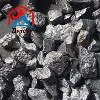
Deoxidising and Alloying Behaviour in Steelmaking
Ferrosilicon has strong deoxidising properties in the steelmaking industry and is a key additive for producing steel that meets its chemical specification. Silicon combines readily with oxygen, so the oxygen dissolved in the bath can be removed in a controlled way instead of forming random porosity and oxide stringers during solidification. In the later stages of the smelting process the molten steel must be deoxidised, and an appropriate addition of ferrosilicon gives a predictable result at the ladle as well as in the furnace.
The same addition works as an alloying agent. Silicon dissolved in steel raises hardness, elasticity and strength, which is why structural, spring, tool and electrical steel grades all carry a specified silicon range. Because the element is cheap compared with most alloying metals and dissolves quickly at steelmaking temperature, ferrosilicon is a practical way to hit both the deoxidation and the alloying target with a single addition.
Inoculation and Spheroidisation in the Cast Iron Industry
Ferrosilicon shows a second set of properties in the cast iron industry, where it acts as an inoculant and as a spheroidising agent. A measured addition to the molten iron prevents the formation of carbides, promotes the precipitation and spheroidisation of graphite, and therefore has a direct influence on the development of ductile iron. Cast iron melts more easily than steel and has excellent casting properties, but it needs its graphite to be in the right form to reach useful mechanical properties. Inoculation with ferrosilicon delivers that result, so the alloy has become one of the standard foundry additions for ductile iron and for high duty grey iron.
In foundry practice the ferrosilicon is usually supplied in a screened size range that matches the ladle or in mould inoculation method used by the foundry, and the addition rate is set by the sulphur and oxygen level of the base iron. A late, well scattered addition gives the strongest inoculation effect, which is why many foundries add a smaller corrective amount in the mould stream rather than relying only on a large ladle addition.
Reducing Agent in Low Carbon Ferroalloy Production
Silicon has a high affinity for oxygen, and high silicon ferrosilicon also carries very little carbon. That combination makes it the standard reducing agent in the ferroalloy industry when low carbon ferroalloys are produced, because a carbon reductant would put back the carbon that the process is trying to remove. The same principle is used in the production of metallic silicon and in a number of metallurgical reduction steps where a carbon free or low carbon reductant is needed.
Powder Applications: Dense Medium, Welding and Chemistry
Ground or atomised ferrosilicon powder is well known in industrial processing. Because the powder can be kept in suspension in water and forms a medium of controlled density, it is used as a suspended phase in the mineral processing industry for dense medium separation, where the heavy medium floats lighter waste rock and sinks the valuable mineral. In welding, ferrosilicon is used as a coating ingredient for welding electrodes, where it deoxidises the weld pool and helps transfer silicon into the deposited metal. In the chemical industry, high silicon ferrosilicon is a raw material for the manufacture of organosilicon products, and the powder form is also used where a fast dissolving addition is needed in the ladle.
Steelmaking: deoxidiser for precipitation and diffusion deoxidation, and alloying agent for silicon bearing grades.
Foundry: inoculant and spheroidising addition for ductile iron and high duty cast iron.
Ferroalloy and silicon production: low carbon reducing agent, for example in low carbon ferrochrome and low carbon ferromanganese.
Mineral processing: ferrosilicon powder as the suspended phase of a heavy separating medium.
Welding and chemicals: electrode coating ingredient and feedstock for organosilicon manufacture.
Choosing the Right Ferrosilicon Grade and Size
Applications differ in the silicon content and the particle size they need. Silicon metal and the higher grade of ferrosilicon are used where the carbon and aluminium limits are tight, while a lower silicon grade is sufficient where the purpose is simple deoxidation. Size selection follows the melting and dissolution behaviour required: lump material for furnace charging, medium sizes for ladle addition, and fine screened powder for the slag surface, for dense medium circuits and for electrode coatings. Buyers normally specify the silicon range, the maximum aluminium, the size band and the packing, and they verify the lot against a certificate of analysis backed by retained samples.
Frequently Asked Questions
Q: What is ferrosilicon mainly used for?
Its largest use is steelmaking, as a deoxidiser and alloying agent. Other major uses are inoculation and spheroidisation in cast iron, low carbon reduction in ferroalloy production, dense medium separation and welding electrode coatings.
Q: How does ferrosilicon improve steel quality?
A controlled silicon addition removes dissolved oxygen, improves the shape of inclusions and lowers dissolved gas content, while the specified silicon level raises strength, hardness and elasticity.
Q: Why is ferrosilicon used for ductile iron?
It prevents carbide formation and promotes precipitation and spheroidisation of graphite, which is what gives ductile iron its mechanical properties, and it also helps the iron melt and cast more easily.
Q: What is ferrosilicon powder used for?
Ground or atomised powder is used as a suspended phase in mineral processing for dense medium separation, as a coating ingredient in welding electrode manufacture, and for diffusion deoxidation on the slag surface.
Q: Why use high silicon ferrosilicon as a reducing agent?
Silicon has a very high affinity for oxygen while high silicon ferrosilicon is low in carbon, so it can reduce oxides without adding the carbon that a low carbon ferroalloy is meant to avoid.
Q: Does ferrosilicon have uses outside metallurgy?
Yes. High silicon ferrosilicon feeds organosilicon manufacture, and fine powder is used in dense medium separation plants and in welding consumable production.