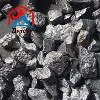
In modern metallurgical production, efficiency, quality stability, and cost control are increasingly important. Traditional additives and alloying materials alone are often no longer sufficient to meet the demands of today's steel plants and metallurgical operations. As a result, 88% and 90% silicon carbide have become widely used materials across the metallurgical industry.
Although silicon carbide has long been known for its hardness and thermal resistance, its value in metallurgy lies mainly in its chemical behavior, multifunctionality, and process stability. Understanding why 88% and 90% silicon carbide are so widely adopted helps metallurgical producers make more informed material choices.
One of the main reasons silicon carbide is widely used in metallurgy is its effectiveness as a deoxidizing agent. When added to molten metal, silicon carbide reacts with oxygen, reducing oxygen content and improving metal cleanliness.
Both 88% and 90% grades provide controlled and steady deoxidation. Compared with traditional deoxidizers that may react too rapidly, silicon carbide offers smoother reaction behavior. The 90% grade, with higher purity, provides more predictable results in processes requiring tighter metallurgical control, while the 88% grade offers reliable performance for large-scale industrial use.
Another key advantage of silicon carbide in metallurgy is its ability to supply both silicon and carbon in a single material. This multifunctionality simplifies alloying operations and reduces the need for multiple additives.
Silicon and carbon are gradually absorbed into the molten metal as silicon carbide dissolves, supporting stable chemical composition adjustment. This dual contribution improves efficiency and reduces operational complexity, making both 88% and 90% silicon carbide highly practical for metallurgical processes.
Process stability is critical in metallurgy, where temperature fluctuations and chemical variations can negatively impact product quality. Silicon carbide contributes to stable process behavior due to its excellent thermal resistance and controlled dissolution characteristics.
Both grades help reduce sudden chemical changes in the melt and support smoother furnace operation. The 90% grade is often selected for processes requiring higher consistency, while the 88% grade is widely used where process tolerance is broader and cost efficiency is a priority.
Large-scale metallurgical operations require materials that are reliable, available, and cost-effective. Silicon carbide meets these requirements by offering consistent performance and flexible application across different metallurgical processes.
The 88% grade is particularly suitable for high-volume consumption due to its excellent cost-performance balance. The 90% grade, while slightly higher in cost, provides improved consistency and lower impurity levels, making it suitable for applications with higher quality requirements.
Compared with traditional deoxidizers and alloying materials, silicon carbide offers several advantages. It combines multiple functions in one material, reduces material handling, and improves process efficiency.
In addition, its stable reaction behavior and thermal resistance help reduce operational risks. These advantages explain why both 88% and 90% silicon carbide are increasingly preferred over single-function additives in modern metallurgical production.

Conclusion
88% and 90% silicon carbide are widely used in metallurgy because they offer effective deoxidation, combined silicon and carbon supply, and stable process performance. Their ability to improve melt quality, production efficiency, and operational reliability makes them valuable materials in modern metallurgical production.
While the 88% grade is favored for large-scale, cost-sensitive operations, the 90% grade provides improved consistency for applications requiring higher quality control. By selecting the appropriate grade and working with a reliable supplier that offers strong production control and logistics capability, metallurgical producers can fully benefit from the advantages of silicon carbide in today's demanding industrial environment.
Our company's advantages in supplying silicon carbide
As an experienced supplier in the metallurgical raw materials industry, we focus on providing 88% and 90% silicon carbide specifically optimized for metallurgical applications.
With long-term experience in production and processing, we operate integrated smelting, crushing, and screening systems. This allows us to control raw materials, furnace parameters, impurity levels, and particle size distribution, ensuring stable chemical behavior and consistent metallurgical performance.
Unlike suppliers that rely mainly on spot trading, our production-based supply model enables us to offer stable long-term supply, flexible specifications, and consistent batch quality.
We also place strong emphasis on packaging and transportation, which directly affect product performance. Our silicon carbide is packed in moisture-resistant, durable packaging such as 25 kg bags or 1 MT jumbo bags, protecting material quality during storage and long-distance transportation. With extensive export experience, we ensure reliable delivery to metallurgical producers worldwide.
By combining controlled production, consistent quality, and professional export service, we help customers improve metallurgical efficiency, reduce operational risk, and maintain stable production performance.