1. The Crystal Structure of Silicon Carbide
Silicon carbide has a tetrahedral crystal structure in which each silicon atom is bonded to four carbon atoms and each carbon to four silicon atoms. The bonds are strongly covalent, which gives the material its extreme hardness and thermal stability. The stacking of the tetrahedral layers can vary, producing many polytypes of the same composition.
2. Alpha and Beta Polytypes
Silicon carbide exists in more than 200 polytypes, which differ in the stacking sequence of the layers. The most common are the cubic beta phase (3C) and the hexagonal alpha phases (4H, 6H and others). The beta phase is favored at lower temperatures, while the alpha phases form at higher temperature, and the phase composition influences the properties and the application of the material.
3. Composition of the Commercial 90% Grade
Commercial 90% silicon carbide contains about 90% SiC, with free silicon, silica and small amounts of iron, aluminium and calcium as the balance. The free silicon and silica come from the production furnace, and their levels are controlled because they affect the metallurgical and refractory behavior. The grade is specified by the SiC content and the impurity limits.
4. Microstructure of the Product
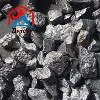
The microstructure of the commercial product consists of silicon carbide grains bonded together, with the free silicon and oxide phases distributed between them. For metallurgical grades, the grain size distribution is controlled by crushing and screening. For refractory products, the microstructure is engineered by the bonding system used in the brick or castable.
5. How Structure Relates to Properties
The tetrahedral structure gives the material its hardness, thermal conductivity and chemical stability. The polytype composition affects the semiconductor properties, which is why electronic-grade silicon carbide is specified by polytype. The grain size and the impurity phases control the behavior in metallurgical additions and refractories. The structure is therefore the link between the grade and its performance.
6. FAQ
Q1: What is the structure of silicon carbide? A tetrahedral crystal structure in which silicon and carbon atoms are each bonded to four of the other, producing extreme hardness and stability.
Q2: What are alpha and beta silicon carbide? Polytypes differing in the stacking of the crystal layers; beta is cubic and alpha is hexagonal, with different formation temperatures.
Q3: What is in commercial 90% SiC? About 90% SiC with free silicon, silica and small impurity amounts.
Q4: Why does the polytype matter? It affects the semiconductor and high-temperature behavior of the material.
Q5: How is the microstructure controlled? By the furnace practice for the crystal form and by crushing, screening and bonding for the commercial product.
Q6: What should buyers specify? The SiC content, phase composition where relevant, impurity limits and particle size.