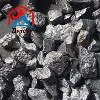
What Is the Basic Crystal Structure
Silicon carbide 88% is composed primarily of silicon (Si) and carbon (C) atoms arranged in a strong covalent crystal lattice. Each silicon atom is bonded to carbon atoms, forming a rigid and stable structure. This covalent bonding is one of the main reasons silicon carbide exhibits high hardness and thermal resistance. Although the 88% grade contains a slightly higher level of impurities than higher-purity grades, its fundamental crystal structure remains the same.
How the Crystal Structure Contributes to Strength
The strength of silicon carbide 88% is largely derived from its tetrahedral crystal bonding structure, which creates strong interatomic bonds that resist deformation, making the material extremely hard and wear resistant. Even under repeated thermal cycling, the crystal structure remains stable, allowing consistent performance over time.
What Role Do Impurities Play
Silicon carbide 88% contains controlled levels of impurities, such as free carbon, silicon oxide, and minor metallic elements, distributed within the material's microstructure rather than fundamentally altering the silicon carbide crystal lattice. While higher impurity content may slightly reduce chemical stability compared with higher-purity grades, the structural integrity remains sufficient for most industrial applications.
How Particle Structure and Size Affect Performance
Beyond crystal structure, particle morphology and size distribution are important structural aspects. Uniform particle size and controlled crushing processes help ensure predictable dissolution behavior and consistent reaction performance in metallurgical processes. Irregular particle structure or excessive fines can negatively affect material handling and performance.
Why the Structure Suits Industrial Use
The combination of strong covalent bonding, stable crystal lattice, and controlled impurity distribution makes silicon carbide 88% structurally well suited for industrial environments. Its structure supports high hardness, thermal stability, and resistance to wear and thermal shock, allowing consistent performance without the higher cost of ultra-high-purity grades.
Frequently Asked Questions
What gives 88% SiC its strength? Its tetrahedral covalent crystal bonding structure, which resists deformation and wear.
Do impurities change the crystal structure? No. Impurities are distributed within the microstructure without fundamentally altering the silicon carbide lattice.
Why does particle structure matter? Uniform particle size ensures predictable dissolution and consistent reaction performance.
Which impurities typically appear in 88% silicon carbide? Free carbon, silicon oxide, and minor metallic elements, present at controlled levels within the microstructure without changing the silicon carbide lattice.
Why does uniform particle size matter for performance? consistent particle distribution ensures predictable dissolution behavior and stable reaction performance in metallurgical and refractory processes.