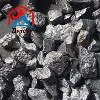
Almost every tonne of steel passes through a ladle or a converter in which at least one ferroalloy has been added. A ferroalloy is a master alloy in which iron carries one or more elements that have a high affinity for oxygen, sulphur or carbon, or that are needed as alloying elements in the finished steel. Ferrosilicon, ferromanganese and ferrochrome are the highest-volume grades; ferromolybdenum, ferrovanadium, ferrotungsten, ferrotitanium and ferroniobium are added in smaller amounts but often decide the properties of the final product.
Why Ferroalloys Are Used Instead of Pure Metals
Pure manganese, chromium or vanadium melts at a very high temperature or is difficult to dissolve in liquid steel. Alloying them with iron produces a master alloy with a lower melting point, a useful density match to steel and a predictable dissolution behaviour. Ferroalloys also reduce the cost per unit of alloying element and make addition control in the ladle practical at industrial scale. Most grades are supplied in defined size ranges, typically 10-50 mm or 10-100 mm lumps, with fines and dust controlled to a permitted maximum.
Role One: Alloy Additives
Alloying is the best known function. Elements are introduced according to the steel composition specification to develop the required combination of strength, hardness, toughness, corrosion resistance or elevated temperature performance. Typical examples include chromium from high-carbon or low-carbon ferrochrome for stainless and heat-resistant grades, manganese from ferromanganese for structural steels, molybdenum from ferromolybdenum for creep and tempering resistance, vanadium from ferrovanadium for grain refinement and precipitation strengthening in high-strength low-alloy steels, and tungsten from ferrotungsten for tool and high-speed steels.
Addition timing depends on the element. Elements with a high affinity for oxygen are added late, in the ladle or during tapping, while more tolerant elements can be added in the furnace. The aim is always to hit the composition window with the lowest possible consumption of the master alloy.
Role Two: Deoxidiser and Desulphuriser
During steelmaking, dissolved oxygen must be removed before casting to prevent blowholes, oxide inclusions and poor surface quality. Ferrosilicon, ferromanganese and calcium-bearing master alloys react with dissolved oxygen and remove it as a slag-forming oxide. Ferromanganese goes further: the manganese produced by dissolution combines with sulphur to form manganese sulphide, which removes sulphur from solution and reduces hot shortness. Calcium-silicon master alloys are used for inclusion shape control, converting hard, angular oxide inclusions into softer globular ones that improve toughness and machinability.
Deoxidation: ferrosilicon, ferromanganese and calcium-silicon master alloys, added before or during tapping.
Desulphurisation: manganese-bearing grades, supported by basic slag practice in the ladle.
Inclusion modification: calcium-bearing master alloys, added after primary deoxidation.
Role Three: Inoculants and Structure Control
Inoculation is the least visible but often the most valuable function. In cast iron, a ferrosilicon-based inoculant is added to the molten iron immediately before casting so that graphite nucleates as fine, evenly distributed flakes or nodules instead of coarse or chilled structures. The result is better machinability, more uniform hardness and fewer hard spots in the casting. In steelmaking, related additions refine the as-cast grain structure and reduce segregation during solidification.
Inoculants depend on correct size grading and timing. Added too early, the nucleating particles dissolve and the effect is lost; added to cold metal, they fail to disperse uniformly.
Role Four: Reducing Agents and Non-Steel Uses
Ferroalloys are also consumed outside steel smelting. Ferrosilicon is the classic reductant in metallothermic production: it is used to reduce calcined dolomite in the silicothermic production of magnesium, and it acts as a reducing agent in the manufacture of other ferroalloys and some non-ferrous metals. Aluminium-bearing and silicon-bearing master alloys serve similar purposes where a strongly reducing environment is required. Smaller volumes go to the chemical industry, to welding consumable manufacture and to the production of non-ferrous alloys.
Common Grades and Their Functions
| Ferroalloy | Typical main element | Primary function |
|---|---|---|
| Ferrosilicon | 72-80 % Si | Deoxidiser, reductant, inoculant |
| High-carbon ferromanganese | 76-82 % Mn, 6-8 % C | Deoxidiser, desulphuriser, alloying |
| High-carbon ferrochrome | 60-70 % Cr, 6-8 % C | Alloying for stainless and heat-resistant steels |
| Ferromolybdenum | 55-65 % Mo | Alloying for creep and tempering resistance |
| Ferrovanadium | 50-80 % V | Grain refinement and strengthening in HSLA steels |
| Ferrotitanium | 30 % or 70 % Ti | Deoxidation, grain refinement, stabilising additions |
| Ferrotungsten | 70-80 % W | Alloying for tool and high-speed steels |
Specified ranges differ between grades and between supplier specifications, so each heat must be added on the basis of the analysis certificate and the required recovery rate rather than on the table alone.
Addition Practice and Recovery
Adding the right alloy in the wrong way wastes both material and furnace time. Three practical rules apply. First, size the addition to the heat weight and the required analysis, allowing for the recovery rate of the element in the specific practice. Second, add the most oxygen-sensitive elements as late as possible, after deoxidation is complete, because reactive elements are lost to slag and to the atmosphere otherwise. Third, stir the ladle sufficiently for complete dissolution without exposing the melt to unnecessary reoxidation, and confirm the final analysis with a sample taken after stirring.
Frequently Asked Questions
Q: What is the main purpose of adding ferroalloys to steel?
They introduce alloying elements, remove dissolved oxygen and sulphur, control the shape of inclusions, refine the cast structure and serve as reducing agents in other metallurgical processes.
Q: Which ferroalloy is the standard deoxidiser?
Ferrosilicon and ferromanganese are the highest-volume deoxidisers, usually supported by calcium-silicon or aluminium additions where inclusion control is critical.
Q: How does ferromanganese improve steel quality?
Manganese both deoxidises the melt and combines with sulphur to form manganese sulphide, which reduces the risk of hot cracking during rolling and forging.
Q: What is inoculation and why does it matter in cast iron?
It is the addition of a ferrosilicon-based master alloy just before casting so that graphite nucleates finely and evenly, giving uniform hardness and better machinability.
Q: Why not add pure chromium or vanadium instead of a ferroalloy?
Ferroalloys melt more readily, dissolve predictably in liquid steel, match the density of the bath better and cost less per unit of alloying element.
Q: When should oxygen-sensitive additions be made?
After primary deoxidation, in the ladle or during tapping, so that the reactive element is not consumed by slag and atmospheric oxygen before it reaches the steel.