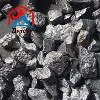
What Ferrosilicon Nitride Contributes to a Molten Steel Bath
Ferrosilicon nitride is a nitride-bearing ferroalloy used as an additive in steelmaking, particularly for special steels that are subsequently forged. It carries nitrogen in a form that dissolves readily in liquid steel, and because its silicon content is also usable, one charge supplies two alloying elements at the same time. Added to the ladle or the furnace, it raises the nitrogen level of the bath while contributing to deoxidation, which is why it is often preferred to other nitrogen carriers when both nitrogen and silicon are wanted.
Beneficial Effects of Nitrogen in Steel
Nitrogen dissolved in steel is not automatically detrimental. In controlled amounts it strengthens ferrite by solid-solution hardening, refines grains through nitride precipitation, and raises hardness and wear resistance. In austenitic grades nitrogen stabilises austenite and allows part of the nickel to be replaced while improving resistance to localised corrosion and raising yield strength without a large loss of ductility. In ferritic special steels a small, deliberately controlled nitrogen addition can improve strength and hardenability.
Harmful Effects: Aging, Blue Brittleness and Toughness Loss
The difficulty with nitrogen is timing. Nitrogen retained in supersaturated solid solution after cooling precipitates slowly as iron nitride, and that precipitation distorts the metal lattice and generates internal stress. The visible consequences are strain aging, a gradual loss of ductility with time, and deterioration of impact toughness. Nitrogen-induced brittleness in low-carbon steel resembles that caused by phosphorus but is generally regarded as more damaging, because it progresses with aging whereas phosphorus embrittlement is a low-temperature effect without an aging component. When phosphorus is already high, the harm attributable to nitrogen is aggravated.
Blue brittleness is the classic symptom. When steel with a high nitrogen content is heated to roughly 250-450 C, the surface takes on a blue temper colour, tensile strength rises and impact toughness falls. Because that temperature band overlaps with welding preheat and with the service conditions of some components, nitrogen control is a welding-quality question as well as a mechanical-property question. As nitrogen content increases, weldability generally deteriorates through porosity and a harder, more crack-sensitive heat-affected zone.
How Aluminium Alters the Nitrogen Balance
Aluminium is the standard corrective element. Adding an appropriate amount of aluminium to the bath forms stable aluminium nitride, which is far less soluble than iron nitride and therefore ties up nitrogen in a harmless, finely dispersed form. The effects are twofold: the nitrogen available to form iron nitride and cause aging is reduced, and the aluminium nitride particles pin austenite grain boundaries and limit grain growth during subsequent hot working. This is the same mechanism that makes aluminium-nitrogen practice useful for grain refinement in special-steel forging.
The dosage window is narrow. Too little aluminium leaves nitrogen free to cause aging; too much leaves coarse alumina inclusions that reduce cleanliness, affect fatigue performance and can clog casting nozzles. Nitrogen and aluminium specifications are therefore always set together rather than independently.
Typical Composition and Addition Practice
| Item | Typical range | Comment |
|---|---|---|
| Nitrogen | 25-32% | Main active element, sets the addition weight |
| Silicon | 45-55% | Contributes to deoxidation and alloying |
| Aluminium | 1.5% maximum | Kept low to limit inclusions |
| Carbon | 0.5% maximum | Relevant for low-carbon steel grades |
| Particle size | 1-10 mm or powder | Controls dissolution rate and recovery |
Charge into the ladle during tapping, or into the furnace after deoxidation, when dissolved oxygen has already been reduced.
Calculate the addition from the target nitrogen content and the assay of the lot, then verify with a bath sample.
Expect lower recovery from fine powder exposed to air and higher recovery from dense granules added at depth.
Check nitrogen and aluminium together after the addition to confirm that free nitrogen has been captured.
Because dissolution is time dependent, an addition made too late in tapping may partly remain in the slag or as undissolved particles, giving a nitrogen result below target even though the heat was charged as if the alloy had fully dissolved. Sampling after a short holding period gives a far more reliable figure than sampling at the instant of addition.
FAQ
Q: Is nitrogen in steel always harmful?
No. Within controlled limits nitrogen strengthens the matrix and refines grain structure; damage arises mainly when excess nitrogen remains in solid solution and precipitates slowly as iron nitride.
Q: What causes blue brittleness?
Heating high-nitrogen steel to about 250-450 C. In that range strength increases while impact toughness falls, and the surface shows a blue temper colour.
Q: Why is nitrogen damage compared with phosphorus?
Both embrittle low-carbon steel. Nitrogen is considered more harmful in this context because its effects progress with time through aging, whereas phosphorus causes low-temperature embrittlement without an aging component.
Q: How does aluminium prevent aging?
It forms stable aluminium nitride, which removes nitrogen from solid solution and prevents slow precipitation of iron nitride. The particles also restrict austenite grain growth.
Q: Can too much aluminium be added?
Yes. Excess aluminium forms coarse alumina inclusions that reduce cleanliness and may clog nozzles, so aluminium and nitrogen are specified together.
Q: How is recovery of the nitrogen addition controlled?
Mainly by particle size, addition depth and timing. Coarse granules added deep in the bath during tapping give the most consistent recovery.