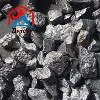
Deoxidation and Alloying in the Steelmaking Industry
The largest use of ferrosilicon is as a deoxidiser and alloying agent in steelmaking. To obtain steel with a qualified chemical composition and reliable properties, deoxidation has to be carried out in the final stage of steelmaking, and silicon has a very large chemical affinity for oxygen, which makes ferrosilicon a strong deoxidiser for both precipitation and diffusion deoxidation. Adding a certain amount of silicon to steel also raises strength, hardness and elasticity in a predictable way, so the element appears in the specification of whole families of steel rather than in a handful of grades.
| Steel family | Silicon content | Role of silicon |
|---|---|---|
| Structural steel | 0.40 to 1.75% | Strength and hardness |
| Tool steel | 0.30 to 1.80% | Hardness and tempering response |
| Spring steel | Specified silicon level | Elastic limit and fatigue resistance |
| Electrical steel for transformers and motors | 2.81 to 4.80% | Electrical resistivity and low core loss |
Improving the shape of inclusions and reducing the content of gas elements in molten steel is an established route to better steel quality, lower cost and less iron consumption, and ferrosilicon fits the deoxidation requirements of continuous casting heats particularly well. In service the alloy has also been shown to give a desulphurisation effect alongside the deoxidation duty, and it offers the practical advantages of a large specific gravity and strong penetrating power when it is added to the ladle.
Inoculation and Spheroidisation in the Cast Iron Industry
Cast iron is an important metal material in modern industry. It is cheaper than steel, melts and smelts easily, has excellent casting properties and absorbs vibration better than steel, and ductile iron in particular reaches or approaches the mechanical properties of steel. That performance depends on the graphite in the iron being in the right form. Adding a certain amount of ferrosilicon to cast iron prevents the formation of carbides and promotes the precipitation and spheroidisation of graphite, which is why the alloy is an important inoculant for graphite precipitation and a standard spheroidising addition in ductile iron production. Magnesium bearing ferrosilicon is used where a stronger spheroidising effect is required, and foundries select the grade and addition rate from the sulphur and oxygen level of the base iron.
Reducing Agent in Ferroalloy Production
Silicon has a very high affinity for oxygen, and high silicon ferrosilicon carries very little carbon. For that reason high silicon ferrosilicon, or silicon alloy, is the commonly used reducing agent in the ferroalloy industry when low carbon ferroalloys are produced. The carbon free nature of the reductant is the decisive property: a carbon reductant would return to the melt exactly the element that the process is trying to keep out, so a silicon reductant is the only practical route to a genuinely low carbon product.
Powder Uses: Ingot Caps, Dense Medium and Welding Coatings
Ferrosilicon in powder form has several distinct uses of its own.
Steel ingot caps: ferrosilicon powder is used as a heating agent for ingot caps, releasing a large amount of heat when it burns at high temperature so that the ingot top stays hot during solidification, which improves both the quality and the recovery of the ingot.
Mineral processing: ground or atomised ferrosilicon powder serves as a suspended phase in the mineral processing industry, forming a controlled density medium in which lighter waste rock floats and the valuable mineral sinks.
Welding: in the welding rod manufacturing industry the powder is used as a coating ingredient that deoxidises the weld pool and controls silicon transfer into the deposited metal.
Chemicals: high silicon ferrosilicon is a feedstock for the manufacture of organosilicon and related products.
Choosing the Grade and Size for Each Use
The four duty groups above pull the specification in different directions. Steel deoxidation and alloying need a consistent silicon level with controlled aluminium, calcium, phosphorus and sulphur, and the size is matched to the addition point, with lump material for furnace charging and medium sizes for ladle addition. Foundry inoculation needs a clean, well screened grade that dissolves quickly in the iron stream. Reduction duty in the ferroalloy industry needs the highest silicon level available with the lowest carbon. Powder applications need a fine, closely graded product: a coarse fraction settles out of a dense medium, while an excessively fine one is carried away in the overflow and is difficult to wet.
Whichever use applies, the lot is normally accepted against a certificate of analysis and a retained sample, with the size distribution and packing checked as part of the same inspection. Third party pre shipment inspection is a useful safeguard for powder grades, where particle size distribution rather than silicon content is the property most likely to fall outside the agreed band.
Frequently Asked Questions
Q: What are the main uses of ferrosilicon?
The main uses are deoxidation and alloying in steelmaking, inoculation and spheroidisation in cast iron, as a low carbon reducing agent in ferroalloy production, and in powder form for ingot caps, dense medium separation and welding electrode coatings.
Q: How much silicon does ferrosilicon add to different steels?
Typical levels are 0.40 to 1.75% in structural steel, 0.30 to 1.80% in tool steel and 2.81 to 4.80% in electrical steel, with spring steel specified according to its required elastic limit.
Q: Why is ferrosilicon powder used on steel ingot caps?
The powder burns at high temperature and releases a large amount of heat, which keeps the ingot top hot during solidification and improves the internal quality and the recovery rate of the ingot.
Q: What makes high silicon ferrosilicon suitable as a reductant?
It combines a very high affinity for oxygen with a very low carbon content, so it can reduce oxides in low carbon ferroalloy production without reintroducing carbon into the product.
Q: What does ferrosilicon do in a dense medium circuit?
Ground ferrosilicon powder is kept in suspension to build a medium of controlled density, allowing lighter waste rock to float and the valuable mineral to sink during separation.
Q: Is ferrosilicon also used in the chemical industry?
Yes. High silicon ferrosilicon is used in the manufacture of organosilicon and other silicon based chemical products, and silicon metal serves similar duties where purity requirements are higher.