Quick Answer: Ferrosilicon particle size for steelmaking is selected according to the charging method, furnace conditions, required dissolution behavior and alloy addition practice. Common commercial forms include ferrosilicon lumps, granules and powder. For bulk steelmaking additions, lump sizes such as 10–50 mm, 10–60 mm and wider size ranges are commonly available, while finer particles are used where faster reaction or controlled feeding is required. The correct size should therefore be specified together with FeSi grade, allowable fines and oversize, packing and quality requirements.
What Is Ferrosilicon Particle Size and Why Does It Matter in Steelmaking?
Ferrosilicon particle size describes the physical size range of the FeSi supplied after crushing and screening. A specification such as 10–50 mm means that the shipment is intended to consist mainly of ferrosilicon pieces within that range, subject to the agreed size tolerance.
Particle size is not only a packing or appearance specification. Ferrosilicon is added to molten steel as a deoxidizer and alloying material, so its physical form affects how the material is charged, handled and exposed to the molten bath.
After smelting and solidification, commercial ferrosilicon is crushed and screened into different size fractions. This is why the same chemical grade can be supplied as lumps, granules or powder for different processes. Microtrac describes commercial FeSi as ranging from dust-like material to centimeter-sized chunks after crushing, followed by screening into separate size grades.

How Particle Size Affects Ferrosilicon Performance
A smaller particle has more surface area relative to its mass and can generally react or dissolve more quickly. Larger lumps expose less surface area and behave differently during charging and dissolution.
For steelmaking, however, smaller does not automatically mean better.
The appropriate ferrosilicon size depends on several practical factors:
- how the alloy is added to the melt;
- the dimensions of the feeding or charging system;
- the amount added at one time;
- molten steel and slag conditions;
- the required dissolution behavior;
- acceptable fines and material losses.
This is why it helps to include a clear particle-size range in your purchase specification instead of simply asking for a general product description.
Common Ferrosilicon Particle Sizes for Steelmaking
Commercial ferrosilicon is available in several particle-size ranges. Across current supplier pages appearing for this search topic, commonly listed sizes include 0–3 mm, 3–10 mm, 10–50 mm, 10–60 mm, 10–100 mm and 50–100 mm, although the exact available range varies by producer and application.
| Ferrosilicon Form | Typical Commercial Size | Typical Use Direction |
|---|---|---|
| Ferrosilicon lump | 10–50 mm | Common steelmaking and bulk alloy addition |
| Ferrosilicon lump | 10–60 mm | General metallurgical charging |
| Larger FeSi lump | 50–100 mm / wider ranges | Bulk addition where the charging system accepts larger pieces |
| Ferrosilicon granules | 1–3 mm / 3–10 mm | Controlled or smaller-particle addition |
| Ferrosilicon powder | Fine powder / mesh-controlled | Specialized processing rather than conventional bulk lump charging |
These ranges are commercial examples, not a universal steelmaking standard. Your actual requirement should be based on the operating practice at your plant.
10–50 mm Ferrosilicon for Steelmaking
Among the pages currently ranking for this topic, 10–50 mm ferrosilicon appears repeatedly as a steelmaking size. ZX Ferroalloy describes 10–50 mm as a steelmaking range, while Taiyue also lists 10–50 mm as a typical particle size for steelmaking.
This relatively controlled lump range can be practical when you need:
- lump material rather than fine powder;
- limited maximum particle size;
- relatively consistent charging;
- lower dust generation than fine ferrosilicon powder.
It should still be confirmed against your plant's charging equipment and operating practice.
10–60 mm and 10–100 mm Ferrosilicon
Wider lump specifications such as 10–60 mm and 10–100 mm are also commercially supplied. Wanhua lists both ranges among its common ferrosilicon particle sizes.
A wider particle-size specification can be acceptable when your charging system can handle the distribution and there is no requirement for tighter size control.
When comparing 10–50 mm and 10–100 mm offers, do not compare only the nominal size. Ask how much undersize and oversize material is allowed. Two quotations can both be described as lump ferrosilicon while having noticeably different actual particle-size distributions.
Ferrosilicon Lump vs Granules vs Powder for Steelmaking
Particle size also changes the physical form in which ferrosilicon is supplied.
Ferrosilicon Lumps
Ferrosilicon lumps are the most familiar form for conventional bulk metallurgical addition.
Typical ranges include:
- 10–50 mm;
- 10–60 mm;
- 10–100 mm;
- 50–100 mm.
Lumps are easier to handle with less dust than fine powder and are commonly associated with bulk steelmaking additions.
Ferrosilicon Granules
Granular ferrosilicon occupies the middle range between large lumps and fine powder.
Commercial examples include:
- 1–3 mm;
- 3–10 mm.
Smaller particles provide greater surface area and can be useful where more controlled feeding or faster interaction with the melt is required. Beifang, for example, lists 0–3 mm, 3–10 mm, 10–50 mm and 50–100 mm as different FeSi particle-size ranges associated with different uses.
Ferrosilicon Powder
Ferrosilicon powder is a separate product form and should not automatically be treated as a substitute for steelmaking lump FeSi.
Fine ferrosilicon can be manufactured and classified into tightly controlled particle-size distributions. Powder-focused applications may specify particle sizes in microns or mesh rather than millimeters.
Its high surface area provides different reaction and handling characteristics, but fine powder also requires more attention to dust, storage, feeding and process suitability.
If your steelmaking process normally uses lump FeSi, changing to powder should be treated as a process decision rather than simply purchasing a smaller particle size.
Ferrosilicon Available in Different Product Forms

Ferrosilicon Lump
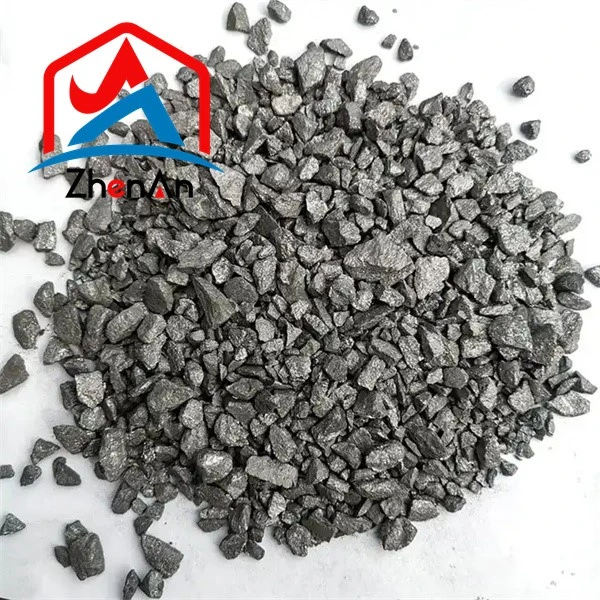
Ferrosilicon Granule

Ferrosilicon Powder
How to Choose Ferrosilicon Particle Size for Different Steelmaking Applications
The suitable ferrosilicon particle size depends on where and how the material is added during steel production. Different steelmaking processes have different requirements for charging efficiency, dissolution behavior, feeding stability and material recovery.
Instead of selecting a particle size only by the nominal range, consider the actual application, such as electric arc furnace charging, ladle treatment, automatic feeding systems or special alloy production.
Ferrosilicon Particle Size for Electric Arc Furnace (EAF) Steelmaking
Electric arc furnace steelmaking commonly uses ferrosilicon as a deoxidizer and silicon alloying material during the melting process.
For EAF applications, lump ferrosilicon such as 10–50 mm or 10–100 mm is often preferred because it provides:
- easy bulk charging;
- lower dust generation compared with fine powder;
- convenient storage and handling;
- stable addition during melting.
The final particle size depends on the charging method and furnace operation. If the charging equipment has limitations on maximum material size, a narrower range may be required.
Ferrosilicon Particle Size for Ladle Treatment and Secondary Steelmaking
During ladle treatment, ferrosilicon is added after primary melting to adjust silicon content and improve steel composition control.
This application usually requires more predictable addition behavior. Suitable particle size selection depends on:
- addition method;
- required silicon recovery;
- steel grade requirements;
- reaction time available during treatment.
Medium-size ferrosilicon lumps or granules may be selected when the plant requires better control of dissolution compared with large pieces.
Ferrosilicon Particle Size for Automatic Feeding Systems
Automatic feeding systems require consistent material flow through hoppers, feeders or conveying equipment.
For these applications, particle-size distribution becomes especially important.
The preferred ferrosilicon size should consider:
- feeding equipment design;
- particle uniformity;
- acceptable fines content;
- risk of bridging or blockage.
Granular ferrosilicon or controlled lump sizes may provide more stable feeding performance compared with irregular large pieces.
Ferrosilicon Particle Size for Special Alloy Production
Some alloy production processes require faster reaction or more precise material addition.
In these cases, smaller ferrosilicon particles or powder may be considered because they provide:
- higher specific surface area;
- faster interaction with the molten material;
- easier control of small additions.
However, fine ferrosilicon also requires better control of storage, transportation and dust protection. It should be selected according to the actual process requirement rather than simply choosing the smallest available size.
Particle Size Selection Should Match the Steel Grade and Production Process
Ferrosilicon particle size should always be considered together with:
- steel grade being produced;
- required silicon content adjustment;
- furnace type;
- addition method;
- production cycle time;
- quality control requirements.
For example, a steel plant producing large-volume carbon steel may prioritize efficient bulk charging, while a specialty steel producer may require tighter control of alloy addition.
Therefore, a complete ferrosilicon specification should include both the chemical grade (such as FeSi75 or FeSi72) and the required particle-size range.

Ferrosilicon Grade and Particle Size Define Different Requirements
Ferrosilicon grade and particle size define different aspects of the material specification. The grade determines the chemical composition, while particle size defines the physical form supplied for steelmaking.
For example, FeSi75 refers to the silicon content grade, but it does not define the particle size. The same FeSi75 material may be supplied in different size ranges, such as 10–50 mm, 10–60 mm or 10–100 mm, depending on the customer's charging and handling requirements.
Therefore, a complete ferrosilicon specification should confirm both the required grade and particle size before quotation. This helps ensure that the supplied material matches the intended steelmaking process.
How Ferrosilicon Particle Size Is Controlled
Ferrosilicon does not leave the furnace naturally as uniform 10–50 mm pieces.
After smelting, molten ferrosilicon is cast and allowed to solidify. The solid alloy is then broken down mechanically, crushed and screened into required size fractions. Microtrac's process description likewise notes that solidified FeSi is crushed and then sifted into different size grades for further use.
A simplified size-control process is:
Smelting → Casting and Cooling → Crushing → Screening → Size Inspection → Packing
This makes screening an important part of particle-size control.
When you require a tighter size distribution, it is useful to confirm:
- nominal size range;
- permitted fines;
- permitted oversize;
- whether the size is checked by screening;
- how samples are taken.
A specification such as 10–50 mm becomes more useful when the tolerance and inspection method are also defined.
Ferrosilicon Particle Size Specification Before Ordering
For steelmaking supply, the particle-size requirement should be specified together with the FeSi grade. Providing only FeSi75 or ferrosilicon lumps is usually not enough to define the required material specification.
| Item | Required Information |
|---|---|
| Ferrosilicon Grade | FeSi75, FeSi72 or other required grade |
| Chemical Composition | Si content and impurity requirements |
| Particle Size | 10–50 mm, 10–60 mm, 10–100 mm or custom size range |
| Quantity | Required metric tons |
| Packing | 1 MT bag, bulk or customer requirement |
| Documents | COA, MTC or inspection requirements |
| Destination Port | Port of delivery for quotation |
When preparing a ferrosilicon specification for steelmaking, the particle-size requirement should be stated together with the FeSi grade. If your plant already uses an approved size distribution, include the exact range in the inquiry instead of using a general term such as "standard size".
A clear particle-size specification helps avoid differences between quotations and ensures that the material supplied matches your charging method, handling system and production requirements. At ZhenAn International, we can review your required FeSi grade and particle-size range before quotation.
Need Ferrosilicon with a Specific Particle Size?
Choosing the correct ferrosilicon particle size depends on your steelmaking process, charging method and material requirements. Send us your FeSi grade, required particle size, quantity and application details. We can confirm the available specification and prepare a quotation based on your requirement.
Frequently Asked Questions
Q: What Is The Common Ferrosilicon Particle Size For Steelmaking?
A: 10–50 mm is one of the particle-size ranges frequently listed for steelmaking ferrosilicon, while suppliers also offer ranges such as 10–60 mm, 10–100 mm and 50–100 mm. There is no single universal size for every plant. The correct range should match your charging system, alloy addition practice and accepted undersize or oversize limits.
Q: Is 10–50 Mm Ferrosilicon Better Than 10–100 Mm?
A: Not necessarily. A 10–50 mm specification provides a narrower upper size range, while 10–100 mm includes larger pieces. Which one is suitable depends on your charging equipment and process requirements. If your system has a maximum lump-size limit or you need more consistent feeding, a tighter range may be preferable.
Q: What Is The Difference Between Ferrosilicon Lumps And Powder?
A: Ferrosilicon lumps are coarse pieces commonly used for bulk metallurgical addition, while ferrosilicon powder has a much smaller particle size and higher surface area. Powder can provide different reaction and feeding behavior but also requires different handling and dust control. It should not automatically replace lump FeSi in an existing steelmaking process.
Q: Does Smaller Ferrosilicon Particle Size Dissolve Faster?
A: Smaller particles generally provide more exposed surface area relative to their mass, which can support faster interaction with the melt. Actual dissolution, however, also depends on temperature, slag conditions, stirring, addition position and FeSi composition. For this reason, the smallest available particle size is not automatically the best choice for steelmaking.
Q: Can FeSi75 Be Supplied In Different Particle Sizes?
A: Yes. FeSi75 is a chemical grade rather than a fixed physical size. Commercial suppliers offer FeSi75 as lumps, granules and finer material in several ranges, including 10–50 mm and 50–100 mm. Your order should state both the required chemical grade and the required particle-size range.
Q: Can The Ferrosilicon Particle Size Be Customized?
A: Particle-size requirements can be discussed according to production and screening capability. When requesting a custom range, specify the minimum and maximum size as well as acceptable fines and oversize material. This gives both sides a measurable specification instead of relying only on terms such as "small lumps" or "large lumps."