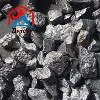
Quick Answer: What Is the Density of Silicon?
The density of crystalline silicon is about 2.33 g/cm³, or approximately 2330 kg/m³, at room temperature. This value describes the true density of solid silicon material. It should not be confused with the bulk density of silicon metal lumps, which is lower because loose pieces contain air gaps between them. Temperature, melting, crystal structure, porosity and material form can also affect the measured or apparent density.
When you see a silicon density value of 2.33 g/cm³, the important condition is that it refers to solid crystalline silicon near room temperature.
For industrial industrial silicon, that number is useful for understanding the material itself, but it does not directly tell you how much space a bag, hopper or container of loose silicon lumps will occupy.

What Is the Density of Silicon at Room Temperature?
At room temperature, crystalline silicon has a density of approximately:
| Property | Value |
| Silicon Density | About 2.33 g/cm³ |
| Silicon Density in kg/m³ | About 2330 kg/m³ |
| Material Form | Solid crystalline silicon |
| Condition | Near room temperature |
The conversion between the two common units is straightforward:
Small differences in published values can result from temperature, purity, crystal defects or measurement conditions. For general engineering work, 2.33 g/cm³ is the standard room-temperature reference.
Why Does Silicon Have a Density of About 2.33 g/cm³?
Silicon density is determined by both its atomic mass and the way silicon atoms are arranged in the crystal.
Silicon has an atomic mass of about 28.09 g/mol and forms a diamond cubic crystal structure under normal conditions.
In this structure, each silicon atom is tetrahedrally bonded to four neighboring silicon atoms. The arrangement is relatively open compared with the more closely packed structures found in many common metals.
This helps explain why silicon, despite having a metallic-looking surface, has a density lower than many structural metals.
How Crystal Structure Determines Silicon Density
For a crystalline material, theoretical density can be related to the number of atoms in a crystal cell, atomic mass and unit-cell volume:
For crystalline silicon, the diamond cubic arrangement places eight silicon atoms in the conventional unit cell. Combined with silicon's atomic mass and lattice dimensions, this gives the familiar density near 2.33 g/cm³ at room temperature.
The key point is that density is not determined by atomic mass alone. The spacing and arrangement of the atoms also matter.
Does Silicon Density Change with Temperature or Material Form?
Yes. The value of 2.33 g/cm³ is a room-temperature reference for crystalline solid silicon. Temperature, phase and internal structure can change the density.
How Does Temperature Affect Silicon Density?
As solid silicon is heated, its crystal lattice expands. The same mass then occupies a slightly larger volume, so the density of solid silicon generally decreases as temperature rises.
For engineering calculations where temperature is far above room temperature, using the room-temperature value without correction may introduce error.
What Is the Density of Solid vs Molten Silicon?
Silicon behaves differently from most common metals when it melts.
Liquid silicon near its melting point is denser than solid crystalline silicon. The liquid density is roughly around 2.5–2.6 g/cm³ near the melting region, depending on temperature and measurement conditions.
This means silicon contracts when it melts and expands when it solidifies, which is the opposite of the behavior seen in many ordinary metals.
Useful distinction: solid crystalline silicon is about 2.33 g/cm³ at room temperature, while molten silicon near the melting point has a higher density.
Does Crystalline vs Amorphous Silicon Change Density?
Yes. Amorphous silicon does not have the same long-range diamond cubic crystal structure as crystalline silicon.
Its density can therefore differ slightly and is also more dependent on deposition method, hydrogen content, porosity and processing conditions.
For ordinary Silicon Metal lump calculations, the 2.33 g/cm³ reference normally refers to crystalline elemental silicon rather than a thin amorphous silicon film.
Do Impurities and Defects Change Silicon Density?
They can, although the effect depends on their amount and distribution.
Industrial Silicon Metal is not chemically identical to ultra-high-purity semiconductor silicon. Commercial grades contain controlled amounts of Fe, Al, Ca and other elements.
Crystal defects, pores, inclusions and impurities can change measured density slightly. However, for most industrial discussions, these effects are much smaller than the difference between true material density and bulk density.
Silicon Density vs Bulk Density: Why Silicon Metal Lumps Show a Lower Number
This distinction is especially important when you work with industrial Silicon Metal lumps.
The true density of silicon describes the mass divided by the actual volume of the solid silicon material itself.
The bulk density of silicon metal lumps describes the mass divided by the total volume occupied by a loose pile of material, including the empty spaces between individual lumps.
| Density Type | What It Measures | Typical Use |
| True Silicon Density | Solid silicon material itself | Material-property calculations |
| Bulk Density | Silicon lumps plus the air spaces between them | Bins, bags, hoppers, transport and storage calculations |
Because loose Silicon Metal lumps cannot fill every part of a container, their bulk density must be lower than the true material density of 2.33 g/cm³.
What Controls the Bulk Density of Silicon Metal Lumps?
Bulk density is not one fixed material constant. It changes with the physical condition of the shipment.
Important variables include:
- Particle Size: 10–50 mm and 50–100 mm material do not necessarily pack in the same way.
- Size Distribution: smaller pieces can fill some of the spaces between larger lumps.
- Lump Shape: angular and irregular pieces create different void volumes.
- Fines Content: fines can significantly change packing behavior.
- Compaction and Vibration: transport or handling can allow loose material to settle.
For this reason, we do not recommend calculating the volume of a Silicon Metal shipment by assuming that every cubic meter contains 2330 kg of loose lumps.
If actual bulk density is important to your silo, bag or hopper design, it should be measured for the relevant grade and Particle Size distribution.
Why Does Silicon Density Matter in Industrial Use?
Silicon density becomes useful when mass has to be converted into volume or when equipment capacity depends on the space occupied by the material.
Silicon Density for Mass and Volume Calculations
For a solid silicon piece:
Using 2330 kg/m³ is appropriate when you are calculating the theoretical volume of solid crystalline silicon itself.
It is not automatically appropriate for a loose pile of Silicon Metal lumps.
Silicon Bulk Density for Handling and Packing
For industrial packing, hopper capacity and material handling, bulk density is often the more practical value.
For example, two Silicon Metal shipments with the same net weight can occupy different volumes if one contains a wider particle-size distribution or more fines.
That is why Particle Size and fines control can matter not only for furnace charging, but also for packing and storage behavior.
Silicon Density and Silicon Metal Specifications
Density is rarely the main acceptance parameter for ordinary metallurgical Silicon Metal. Chemical Composition and Particle Size are normally more important in a purchase specification.
For example, grades such as 553, 441, 421, 3303 and 2202 are generally differentiated primarily by controlled impurity levels rather than by large changes in the intrinsic density of silicon.
You can review our Silicon Metal 553 vs 441 comparison to see how grade selection is driven by Fe, Al, Ca and application requirements.
For another commercial specification reference, see our Silicon Metal 421 specification .
In our Silicon Metal supply work, we confirm the required grade, Chemical Composition, Particle Size and Batch COA before shipment. If bulk density is critical to your feeding, silo or packing system, it should be defined as a separate physical requirement instead of being assumed from the theoretical silicon density.
Key Takeaways on Silicon Density
Crystalline silicon has a density of about 2.33 g/cm³ at room temperature. This is equivalent to approximately 2330 kg/m³.
Silicon density changes with temperature and phase. Solid silicon becomes slightly less dense as it is heated, while molten silicon near the melting point is denser than the solid.
True density and bulk density are different. The 2.33 g/cm³ value describes solid silicon itself, not loose Silicon Metal lumps.
Silicon Metal lump bulk density is lower because of void spaces. Particle Size, shape, fines and packing condition all influence the measured value.
For purchasing, Chemical Composition and Particle Size usually matter more than theoretical density. Bulk density should be specified separately when it affects storage, transport or feeding equipment.
Silicon Density FAQ
Q: What Is Silicon Density in kg/m³?
A: The density of crystalline silicon at room temperature is approximately 2330 kg/m³, equivalent to about 2.33 g/cm³. This value refers to the solid material itself rather than the bulk density of loose Silicon Metal lumps.
Q: Does Silicon Become Denser When It Melts?
A: Yes. Silicon is unusual because liquid silicon near the melting point is denser than solid crystalline silicon. Its liquid density is roughly around 2.5–2.6 g/cm³ near the melting region, depending on temperature and measurement conditions.
Q: Is Silicon Denser Than Aluminum?
A: No. Crystalline silicon is about 2.33 g/cm³ at room temperature, while aluminum is about 2.70 g/cm³. Silicon is therefore less dense than aluminum under comparable room-temperature conditions.
Q: Why Is Silicon Metal Bulk Density Lower Than 2.33 g/cm³?
A: The 2.33 g/cm³ value is the true density of solid crystalline silicon. Loose Silicon Metal lumps contain air spaces between individual pieces, so the mass divided by the total occupied volume gives a lower bulk density. Particle Size, shape and fines content also affect the result.
Check Silicon Metal Specifications
If you are selecting industrial Silicon Metal, density is only one material property. Confirm the required grade, Fe/Al/Ca limits, Particle Size and Batch COA before selecting the material.
If bulk density affects your hopper, packing or feeding system, include the required measurement condition in your specification so it can be checked separately from the theoretical density of silicon.
Check Silicon Metal Specifications