Direct Conclusion: For most thermal spray workshops, DIN 340 zinc wire spools with 20–25kg net weight are the common choice. KE300 spools fit some 300mm flange feeder systems, while 250kg drum packing is better for continuous spraying lines. Zinc wire should be stored dry, sealed, and below 60% relative humidity.
When you choose zinc wire packing, do not only check spool weight. We suggest confirming flange diameter, hub size, payout method, feeder model, warehouse humidity, pallet loading and MTC documents before shipment. These details directly affect wire feeding, storage safety and workshop handling.
Standard Zinc Wire Spool Types We Supply
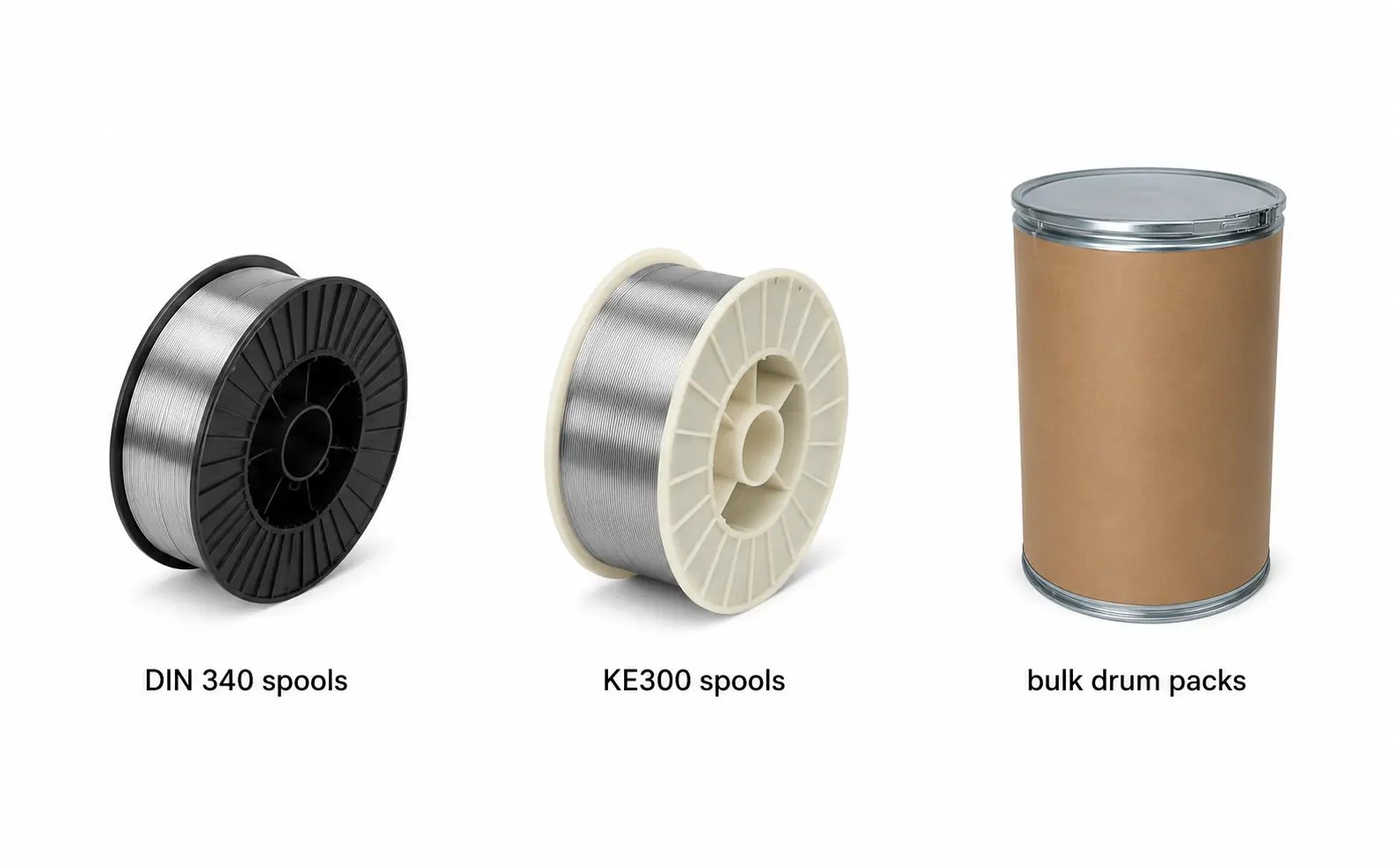
We manufacture and stock zinc wire in three packaging formats, each designed for different production volumes and feeder types:
| Parameter | DIN 340 Spool | KE300 Spool | Drum Pack Bulk |
|---|---|---|---|
| Wire capacity | 20–25 kg | 18 kg / 40–44 lb | 250–300 kg |
| Flange diameter | 340 mm | 300 mm | N/A drum |
| Core diameter | 100–127 mm | 127 mm | N/A |
| Max O.D. | 340 mm | 300 mm | N/A |
| Payout type | Centrifugal rotating | Centrifugal | Traverse wound |
| Standard region | Europe DIN | North America | Global export |
| Typical feeder compatibility | Most arc spray guns | Mogul / TAFA feeders | Bulk feed systems |
Matching Spool Type to Feeder System
Compatibility depends on the thermal spray equipment manufacturer. Here is our guidance:
- Metco / Oerlikon feeders - typically designed for DIN 340 spools 20–25 kg. The 340 mm flange fits standard hub adapters.
- TAFA / Praxair arc spray systems - often use KE300 spools 18 kg. We recommend checking the feed hub diameter before ordering.
- Rokide / custom bulk systems - 250 kg drums with traverse-wound payout are most efficient for high-volume production, providing 8+ hours of continuous spray per drum.
To identify the correct format, measure the spool flange diameter: 340 mm indicates DIN 340, and 300 mm indicates KE300. We offer all three formats and can supply adapter hubs when needed. For our zinc wire for thermal spray, each shipment is packed to match the specified feeder type.
Payout Options - Centrifugal vs Traverse Wound
The payout method affects feed reliability:
- Centrifugal spool rotates - the spool sits on a hub and rotates as wire is pulled. Low tension, ideal for arc spray. Available on DIN 340 and KE300 spools from our production line.
- Traverse wound stationary drum - wire is wound in layers on a stationary drum and pulled axially. Higher tension, suited for flame spray and bulk systems. Standard for our 250 kg+ drums.
For most arc spray applications, centrifugal payout on DIN 340 spools is the preferred configuration. We stock and ship this format by default unless otherwise specified.

Zinc Wire Storage Conditions
While zinc is more resistant to corrosion than steel wire, improper storage can still cause surface contamination that affects spray quality. We recommend the following parameters:
| Parameter | Recommended Range |
|---|---|
| Temperature | 10–30°C / 50–86°F |
| Relative humidity | < 60% |
| Dew point margin | ≥ 5°C above dew point |
| Original packaging | Keep sealed until use |
| Stacking height | Max 3 spools high DIN 340 |
| Away from | Acids, alkalis, solvents, aggressive chemicals |
Handling Guidelines - Avoiding Kinking & Surface Damage
Zinc wire is relatively soft compared to steel, making it susceptible to mechanical damage during handling. We recommend these practices:
- Lift by the flange - always lift spools by the flange, never by the wire layers
- Keep away from sharp edges - when stringing wire, avoid contact with sharp corners on fixtures
- Maintain tension - loose wire can cause tangles and kinks during pay-out
- Inspect before use - check the first 2 meters for surface damage, bends, or embedded particles
- Use gloves - handling zinc wire with bare hands transfers oils that may affect coating adhesion
Shelf Life of Zinc Wire
Zinc wire does not have a defined expiration date. Unlike organic materials such as sealants, paints and polymers, zinc metal is chemically stable under normal storage conditions. The wire surface naturally develops a thin, protective zinc oxide layer, also called passivation, which does not degrade thermal spray performance.
However, if storage conditions are consistently outside the recommended range, or if the wire is exposed to condensation cycles, white rust or zinc hydroxide can form. Light white rust can be removed by wire brushing the first few meters. Heavy corrosion requires discarding the affected wire. All shipments from Zhenan New Materials are packed with moisture-barrier wrapping for ocean freight protection.
Our Export Packaging Standards
We pack zinc wire for international shipments to withstand ocean freight and container transport:
- Pallet type - heat-treated ISPM-15 compliant plywood or plastic pallets
- Bundling - shrink-wrapped per layer with anti-slip separators between spool layers
- Container loading - 20 ft container: about 18 pallets of DIN 340 spools, approx. 10–12 tons net
- 40 ft container - about 36 pallets, approx. 20–24 tons net
- Drum export - 250 kg drums are individually strapped and loaded upright
- Documentation - packing list, bill of lading, certificate of origin, Type 3.1 MTC included in each shipment
Frequently Asked Questions About Zinc Wire Spool Sizes and Storage
Q:What zinc wire spool size should I choose for arc spray equipment?
A:For most arc spray equipment, we usually recommend DIN 340 spools with 20–25 kg net weight. If your feeder uses a 300 mm flange or North American-style setup, KE300 spools may fit better. Before production, we suggest you confirm the flange diameter, hub size and feeder model with us.
Q:What is the difference between DIN 340 and KE300 zinc wire spools?
A:DIN 340 spools usually have a 340 mm flange and are common in European-style thermal spray systems. KE300 spools usually have a 300 mm flange and are often used in North American equipment. We can supply both formats according to your feeder requirement.
Q:How should I store zinc wire before spraying?
A:We recommend storing zinc wire in a dry and ventilated warehouse, with temperature around 10–30°C and relative humidity below 60%. Keep the spools sealed in the original packaging before use, and avoid condensation, rainwater, acids, alkalis and corrosive chemicals.
Q:Does zinc wire have a shelf life?
A:Zinc wire does not have a fixed expiration date when stored correctly. The surface may form a thin zinc oxide film during storage, which is normal. However, if the wire is exposed to moisture for a long time and develops heavy white rust, we suggest checking the surface condition before feeding it into the spray equipment.
Q:Can we supply zinc wire in bulk drum packing?
A:Yes. For continuous spraying lines or high-volume production, we can supply zinc wire in 250 kg drum packing. Drum packing reduces spool change frequency and helps your workshop keep longer spraying runs. We can also provide packing photos, pallet loading details and MTC documents before shipment.
Need Zinc Wire in a Specific Spool Format?
Zhenan New Materials - over 30 years manufacturing zinc wire for thermal spray. We supply DIN 340, KE300, and bulk drum packaging in all standard diameters and purity grades, with full MTC documentation. Custom spool labeling and packaging options are available for OEM and distributor programs.
Contact our export team for spool samples, FCL loading plans, and custom packaging quotations.
Get Spool & Packaging Quote