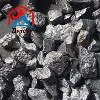
Medium carbon ferromanganese sits between the high carbon and low carbon families and is chosen when a manganese addition has to be made without pushing the carbon content of the steel out of specification. Its effect on low carbon, medium carbon and high carbon steels is therefore not identical: the same alloy that comfortably fits a structural steel may be unusable in a low carbon sheet grade or a critical tool steel. This article sets out how the alloy behaves across the carbon range and how to select the right grade for each family.
Why Grade Selection Determines the Carbon Balance
The carbon introduced by a ferromanganese addition is easily calculated and is often underestimated. Adding one tonne of a medium carbon grade containing 2.0% carbon to a 100 tonne heat introduces 20 kg of carbon into roughly 101 tonnes of steel, a pickup of about 0.020%. The same addition made with a high carbon grade containing 7.5% carbon introduces 75 kg, equivalent to about 0.074%. The difference of roughly 0.054% carbon is larger than the entire specification range of many low carbon and interstitial-free sheet grades, which is precisely why medium carbon and low carbon ferromanganese exist.
| Grade added, 1 tonne | Carbon introduced | Pickup in a 100 tonne heat | Suitable for |
|---|---|---|---|
| High carbon ferromanganese, 7.5% C | 75 kg | about 0.074% | Structural, long and heavy section products |
| Medium carbon ferromanganese, 2.0% C | 20 kg | about 0.020% | Forging, spring and engineering grades |
| Medium carbon ferromanganese, 1.5% C | 15 kg | about 0.015% | Tight carbon engineering grades |
| Low carbon ferromanganese, 0.5% C | 5 kg | about 0.005% | Sheet, low carbon and interstitial-free grades |
The figures illustrate the dilution logic rather than fixed plant values, since the actual pickup depends on heat size, recovery and the rest of the charge. The principle is what matters: carbon control begins with the choice of alloy grade, not with a correction applied afterwards.
Effect on Low Carbon Steel
Low carbon steels, broadly those below about 0.25% carbon, are produced for automotive panels, building structures and general machinery, where ductility, weldability and forming behaviour are the deciding properties. Manganese additions in the range of roughly 0.30-0.80% raise tensile strength and hardness by solid solution strengthening and improve the hardenability of the steel without destroying its ductility. Grain refinement of the ferrite also improves the balance between strength and toughness, which is why manganese is retained in most structural specifications rather than being treated as an impurity.
The limiting factor is formability. Low carbon sheet grades, and especially deep drawing and interstitial-free grades, have tight carbon ceilings, so the carbon carried by the alloy addition is usually the constraint rather than the manganese recovery. Medium carbon ferromanganese at 1.5-2.0% carbon is usable where the carbon budget allows; low carbon grades are the safer choice for interstitial-free and exposed panel applications. Excessive manganese in a drawing grade can also raise hardness and reduce the plastic strain ratio that governs deep drawability, so the addition should be sized against the target property rather than simply to the top of the specification range.
Effect on Medium Carbon Steel
Medium carbon steels in the 0.25-0.60% carbon range are the backbone of machinery, shafts, gears and forgings, and they are where medium carbon ferromanganese is used most naturally. Manganese at roughly 0.60-1.00% markedly improves hardenability, allowing a component to be through hardened in sections that would otherwise require a more severe quench or additional alloying elements. The practical benefits are higher and more uniform hardness after heat treatment, better fatigue performance and improved wear resistance in service.
At the same time, manganese reduces the brittleness associated with some high carbon microstructures when it is balanced correctly, and grain refinement from a controlled addition improves the uniformity of the microstructure. Two cautions apply. Manganese sulphide stringers introduced with the alloy can create directionality, so transverse properties should be checked on critical forgings. And because medium carbon steels are often welded, manganese levels at the top of the range increase hardenability in the heat affected zone and the risk of cold cracking, which usually means preheat control or a carbon equivalent limit rather than a change of alloy.
Effect on High Carbon Steel
High carbon steels above roughly 0.60% carbon are used for tools, springs, bearing components and wire products, where hardness and wear resistance dominate. Manganese retains a useful role here. In the typical range of 0.30-0.90% it improves hardenability and wear resistance while preserving enough toughness for the duty, and it is a standard element in spring steel specifications alongside silicon and chromium.
The carbon budget, however, becomes critical. High carbon steels already sit close to their carbon specification, and some grades, notably high carbon chromium bearing steels with roughly 1.0% carbon, tolerate only a narrow manganese band of about 0.25-0.45%. Any uncontrolled carbon pickup from the alloy addition is unacceptable in these products, and it can also be uneconomic to remove. Medium carbon ferromanganese with a carbon content of 1.5-2.0%, or a low carbon grade, is normally selected for such heats.
Retained austenite is the other consideration. In high carbon grades, manganese stabilises austenite and increases the depth of hardening, which is helpful for wear resistance but risks dimensional instability and cracking if the tempering cycle is not adjusted. Producers manage this by measuring retained austenite and tempering for longer, and by keeping manganese within the band that the grade was qualified on.
Recovery, Cost and Practical Selection
Recovery of manganese from the alloy is high but not complete, and it depends on the oxygen potential of the bath, the addition practice and the particle size of the material charged. Fines are lost to the slag more readily than lump, and wet alloy introduces hydrogen. Buyers comparing grades should therefore work in cost per kilogram of manganese recovered rather than in cost per tonne of alloy, and should validate the recovery figure on their own heats.
Choose high carbon ferromanganese for structural and long products where carbon pickup is acceptable and manganese cost per unit is the priority.
Choose medium carbon ferromanganese for forging, spring and engineering grades where the carbon ceiling is real but not extremely tight.
Choose low carbon ferromanganese for sheet, low carbon and interstitial-free grades, and for any heat where the carbon budget cannot absorb an additional 0.02%.
Specify the applicable grade limits against ISO 5446, ASTM A99/A99M or GB/T 3795, and require lot certification of manganese, carbon, silicon, phosphorus and sulphur.
Frequently Asked Questions
Q: Can medium carbon ferromanganese be used in low carbon steel?
Yes, where the carbon budget allows. The addition raises carbon by roughly 0.015-0.020% per tonne added to a 100 tonne heat, so it is suitable for many low carbon grades but not for interstitial-free or tightly specified sheet.
Q: What carbon content distinguishes medium carbon ferromanganese?
Typical commercial medium carbon grades carry about 1.0-2.0% carbon, compared with 6.0-7.5% in high carbon grades and 0.5% or less in low carbon grades. The exact limits follow the agreed grade and supplier specification.
Q: Does manganese reduce brittleness in high carbon steel?
Manganese improves hardenability and, with correct heat treatment, helps balance hardness against toughness. It does not remove the need for tempering, and excessive retained austenite can make high carbon parts less stable rather than tougher.
Q: How much manganese should a spring steel contain?
Spring steel grades commonly contain about 0.50-1.00% manganese alongside silicon and chromium, with the exact range set by the grade specification and the required hardenability for the wire or bar section.
Q: Why do bearing steels restrict manganese so tightly?
High carbon chromium bearing steels already operate near their carbon limit and rely on a very controlled microstructure for fatigue life. Manganese is kept in a narrow band of roughly 0.25-0.45% to avoid excessive retained austenite and dimensional instability.
Q: Does medium carbon ferromanganese cost more per unit of manganese?
Generally yes, because of the additional refining and lower carbon content. It is justified whenever the carbon ceiling of the steel makes a high carbon addition impossible without off specification product.