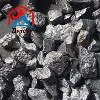
Silicon carbide and silicon carbide powder are often quoted as if they were two different materials. They are not. Both are built from the same covalent compound of silicon and carbon; the difference lies in form, particle size distribution, surface condition and the process route used to reach that form. Understanding the split matters commercially, because a purchase specification written for bulk grain will not control the properties that decide performance in a slurry, a coating or a sintered ceramic body.
One Material, Two Product Forms
Silicon carbide in its bulk form is a hard, refractory solid: hardness close to that of diamond on the abrasive scale, melting behaviour above 2700 degrees Celsius with decomposition rather than simple melting, high thermal conductivity, low thermal expansion and good chemical stability. It is supplied as lump, grain or shaped refractories and is used where wear, heat or chemical attack would destroy ordinary materials.
Silicon carbide powder is the same compound after crushing, milling, classification and, in many grades, chemical purification. The chemistry is unchanged, but the particle size is reduced from millimetres to micrometres, which raises specific surface area by orders of magnitude and changes how the material behaves in every downstream process.
| Characteristic | Bulk silicon carbide | Silicon carbide powder |
|---|---|---|
| Typical size | Millimetre-scale grain, lump or shaped part | Micrometre to sub-micrometre particles |
| Specific surface area | Low, controlled by grain size | High, often several square metres per gram |
| Primary use | Refractories, abrasives, wear linings | Coatings, slurries, ceramics, powder metallurgy |
| Key purchase control | Grain size, chemistry, bulk density | Particle size distribution, surface area, dispersion |
Particle Size, Surface Area and Grade Designations
Bulk abrasive grain is normally specified on bonded and coated abrasive sizing systems such as the FEPA F series, ISO 8486, JIS R6001 and the ANSI B74 sieve designations, where a nominal grit number corresponds to a controlled size band. Powders move to a different language: median particle size, or d50, plus the width of the distribution and the top cut. Micron grades below the smallest sieve sizes are designated on microgrit scales such as the FEPA D series or ISO 8486-2, and ceramic grade powders are frequently specified only by d50, specific surface area and chemistry.
Coarse grain, typically above 45 micrometres: abrasive and refractory duties.
Mid-range powder, roughly 5-45 micrometres: coatings, wear composites and bonded ceramics.
Fine and sub-micron powder, below 5 micrometres: advanced ceramics, slurries and sintered parts.
Two suppliers can quote the same d50 and deliver very different behaviour, because specific surface area, agglomeration state, particle shape and surface chemistry also control sintering shrinkage, slurry rheology and coating uniformity. A meaningful specification therefore lists a size distribution with a top cut, not a single average value.
How Each Form Is Made
Bulk silicon carbide is produced in resistance furnaces from a mixture of high purity quartz sand and a carbon source such as petroleum coke, with salt and sawdust additions to control the reaction and improve porosity. The furnace is heated for days, then cooled and the crust broken out. The core material is high purity black silicon carbide; the outer, less pure zone is downgraded to metallurgical or refractory use. Green silicon carbide is made in the same way but with higher purity feedstock and a different charge mix, giving higher purity and lower free iron, which suits lapping and precision finishing duties.
Powder production starts from selected bulk material. The route usually runs through jaw and roll crushing, then ball milling, stirred media milling or jet milling to reach the target size, followed by air classification or sedimentation to cut the distribution. Acid washing removes free iron and other contaminants picked up from the milling media. Ceramic grade powders are often made by a different chemistry route entirely, for example carbothermal reduction of silica with carbon black, so that sintering additives and surface condition can be controlled from the start.
Application Mapping: Choosing the Right Form
| Application | Preferred form | Reason |
|---|---|---|
| Blast furnace and ladle refractories | Bulk grain and shaped brick | Thermal shock and slag resistance at high loading |
| Grinding wheels and coated abrasives | Sized grain | Cutting performance depends on grain strength and shape |
| Reaction bonded and sintered ceramics | Fine powder | Sintering kinetics depend on surface area and purity |
| Wear coatings and polymer composites | Powder | Dispersion and loading level control wear life |
| Powder metallurgy preforms | Powder | Compaction and shrinkage behaviour |
A frequent purchasing error is to treat powder as simply finer grain. In practice, the two products are usually bought to different specifications, packed differently, handled differently and priced on different bases, and substituting one for the other without re-qualifying the process is a common cause of scrap.
Specification Checklist for Buyers
Silicon carbide content on a dry basis, with free carbon, free silica and metallic iron reported separately.
Particle size distribution with d10, d50 and d90, plus a stated top cut and a sieve oversize limit.
Specific surface area for ceramic and coating grades, measured by gas adsorption.
Magnetic iron and moisture content, both of which affect ceramics and abrasive bonds.
pH or surface condition for slurry and coating use, since this drives dispersion stability.
Crystal type, alpha or beta, when sintering or thermal conductivity is critical.
Frequently Asked Questions
Q: Is silicon carbide powder a different chemical from silicon carbide?
No. Both are the same silicon and carbon compound. Powder is the milled and classified form, with a much smaller particle size and a far higher specific surface area.
Q: Can I mill bulk grain myself to make powder?
It is technically possible, but the resulting distribution is usually too wide and iron pickup from the milling media is high. Controlled milling plus classification and acid washing is what makes a specification grade of powder.
Q: What is the difference between black and green silicon carbide?
Black silicon carbide is produced from a standard charge and suits refractories, wear parts and general abrasives. Green silicon carbide is made from higher purity feedstock, giving lower free iron and better performance in precision lapping and fine grinding.
Q: Why does my coating behave differently when the d50 is unchanged?
Because d50 alone does not describe a distribution. Changes in the coarse end, the fines level, agglomeration and surface condition alter rheology, sedimentation and wear performance even when the average size matches.
Q: How should silicon carbide powder be stored?
Keep it sealed and dry. Fine powder takes up moisture readily, which degrades flowability, raises hydrogen pickup in sintered parts and changes the solids loading of slurries.
Q: Which form should be used for thermal management parts?
Powder, normally a ceramic grade with controlled purity and crystal type, because thermal conductivity in the finished part depends on sintering density, grain boundary chemistry and phase composition rather than on the bulk material alone.