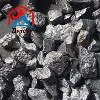
Ferromanganese is the master alloy through which steelmakers add manganese, and automotive steel is one of the largest end uses for it. In basic oxygen and electric arc furnaces the alloy is charged or ladle added to do three jobs at once: deoxidise the melt, tie up residual sulphur as manganese sulphide, and leave the balance of the manganese in solution as an alloying element. A typical body panel or chassis steel carries 0.3-1.5% Mn, advanced high-strength steel grades carry roughly 1.5-3.0% Mn, and the high-manganese austenitic concepts under development for structural parts push far above that range.
Because manganese is introduced as a master alloy rather than as pure metal, the ferromanganese grade selected also fixes how much carbon, phosphorus and sulphur enter the heat. That single relationship explains most of the technical direction now visible in car-body steelmaking, and it is why grade selection has moved from a purchasing detail to a metallurgical decision.
Where Ferromanganese Fits in Automotive Steelmaking
Three commercial families dominate deliveries to vehicle steel producers. The table below shows typical delivered ranges; the binding limits are those of the agreed grade in the purchase specification, normally written against ISO 5446, ASTM A99/A99M or GB/T 3795.
| Grade family | Mn (%) | C (%) | Si (%) | Typical automotive use |
|---|---|---|---|---|
| High carbon ferromanganese | 75-82 | 6.0-7.5 | max 2.0 | Bulk deoxidation and manganese alloying in structural and long products |
| Medium carbon ferromanganese | 78-85 | 1.0-2.0 | max 1.5 | Manganese additions where carbon pickup must stay low |
| Low carbon ferromanganese | 80-90 | max 0.5 | max 1.0 | Sheet steels, low carbon and interstitial-free grades |
Manganese recovery in the ladle is normally high, but it is never complete, so buyers should budget on measured recovery from their own heats rather than on the nominal manganese content alone. Fines content, lump size and moisture all shift the effective recovery and therefore the real cost per kilogram of manganese in the steel.
Trend 1: Rising Manganese in Advanced High-Strength Steels
The strongest demand signal for ferromanganese comes from advanced high-strength steel families. Dual-phase, complex-phase and transformation-induced plasticity grades rely on manganese for solid solution strengthening and for hardenability control, and manganese contents in the 1.5-3.0% band are now routine. Medium-manganese transformation-induced plasticity concepts, commonly discussed in the 3-12% Mn range, and high-manganese austenitic grades above 12% Mn extend that logic further: they trade manganese content for an unusual combination of strength and elongation that lets designers thin down a component without losing crash performance.
For the alloy supplier this changes the product mix. Higher manganese additions mean larger tonnages per heat, but the carbon ceiling becomes tighter because sheet steels are sensitive to carbon. The practical result is sustained growth in medium carbon and low carbon ferromanganese at the expense of the high carbon grade, and a stronger focus on consistent chemistry from lot to lot.
Trend 2: Lightweighting, Crash Performance and Body Structures
Lightweighting programmes remain the main driver behind new steel chemistries. It is worth stating the physics plainly: ferromanganese is a dense master alloy with a density of roughly 7.0-7.4 g/cm3, and it is not itself a low-density structural material. Weight saving is delivered by the finished steel, whose density stays close to that of ordinary steel but which can be used in thinner sections because manganese raises strength, hardenability and strain-hardening capacity. Crash-relevant properties such as energy absorption, hole expansion and bendability are then tuned through the manganese, carbon and microalloying balance rather than by the master alloy acting as a structural phase.
In practice this means the alloy specification must support formability as well as strength. A grade that delivers the target manganese content but carries excessive sulphur raises the risk of elongated manganese sulphide inclusions, which damage bendability and flange cracking on high-strength body parts. Forgiving, clean deliveries are what body-in-white programmes are actually buying.
Trend 3: Cleaner Grades and Tighter Impurity Control
Impurity limits in ferromanganese have tightened steadily. Phosphorus in high carbon grades is often specified at or below 0.35% and is being pushed toward 0.20% or lower for demanding sheet applications, while sulphur limits of 0.03-0.05% are common and lower figures are requested for high-manganese grades. Carbon control follows the same pattern, with low carbon grades specified at 0.5% C maximum and premium lots well below that.
Consistent lump size, typically 10-50 mm or 10-100 mm depending on the furnace, with a fines allowance agreed at the point of order.
Moisture control, since wet alloy carries hydrogen and adds unpredictable weight to the charge.
Lot level chemistry certification for Mn, C, Si, P and S, so that recovery calculations can be closed out after each heat.
Trend 4: Electrification, Supply Reality and Corrected Property Claims
Electrification has not removed the need for manganese in vehicles, but it has changed where the steel sits. Battery enclosures, motor housings, seat structures and crash-relevant body sections still use manganese-bearing steels, and hot-end components such as exhaust manifolds and turbocharger housings depend on heat-resistant grades where the alloying balance is carefully controlled.
Two claims that circulate in supplier literature should be corrected. First, ferromanganese is not chosen for electrical conductivity; adding manganese to steel in fact raises electrical resistivity, so ferromanganese is not a conductor material for electrical components. Second, manganese does not automatically improve corrosion resistance: manganese sulphide inclusions are well known as initiation sites for pitting, and manganese oxides are less protective than chromium-rich scales in stainless grades. The honest position is that manganese buys strength, hardenability and cost-effective alloying, while corrosion performance is managed through sulphur control, inclusion shape treatment and the chromium or aluminium balance of the steel itself.
Frequently Asked Questions
Q: Is manganese added to automotive steel as pure metal or as ferromanganese?
It is almost always added as ferromanganese, because the master alloy melts readily, has a predictable density for ladle addition, and costs far less than electrolytic manganese metal. Electrolytic manganese is reserved for grades with very low carbon and nitrogen ceilings.
Q: How much ferromanganese is needed for a 0.8% manganese steel?
On a clean basis, a 78% Mn grade requires about 10.3 kg per tonne of steel for a 0.8% manganese target, before allowing for recovery losses and dilution from other additions. Using measured recovery from plant trials is the only reliable way to set a charge figure.
Q: Why is low carbon ferromanganese used for sheet steels?
Sheet and interstitial-free grades have very tight carbon limits. Every percentage point of carbon in the master alloy is diluted into the heat, so a low carbon grade keeps the carbon rise from the manganese addition inside the steel specification.
Q: Does higher manganese always mean better wear resistance?
No. Manganese raises hardness and hardenability up to a point, but wear resistance depends on the final microstructure, carbide distribution and service conditions. Excess manganese with the wrong heat treatment can leave unstable retained austenite and reduce dimensional stability.
Q: What is a sensible impurity limit to request?
For automotive sheet work, requesting phosphorus at 0.20% maximum, sulphur at 0.03% maximum and a fines allowance below 5% is a realistic starting point. Tighter limits are available but should be justified by a measured process need, since they carry a price premium.
Q: How should ferromanganese be stored before charging?
Keep it dry and covered. Ferromanganese fines are hygroscopic in humid conditions, and moisture carried into the melt adds hydrogen, which raises the risk of porosity and delayed cracking in cast or rolled product.