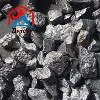
1. What Ferrosilicon Grains Are
Ferrosilicon grains are the granular form of the alloy, with particle sizes typically in the 1 to 10 mm range, produced by crushing, screening and classifying standard ferrosilicon. The grain form combines the metallurgical function of the alloy with controlled dissolution and accurate dosing, which makes it suitable for applications where lump material is too coarse and powder too fine.
2. Fine Dosing in Steelmaking
In steelmaking, ferrosilicon grains are used for fine dosing of silicon where the target level must be controlled accurately. The small, uniform particles dissolve quickly and distribute evenly, allowing the operator to make precise corrections to the bath chemistry without overshooting. The grain size and the low fines content support consistent dosing.
3. Foundry Inoculation
In foundry work, ferrosilicon grains are used as inoculants for cast iron, where they promote graphite nucleation and improve the structure of the casting. The grain size is matched to the inoculation method, and the controlled dissolution helps manage the fading of the inoculant effect. Barium, calcium and strontium-bearing grain grades provide improved fading resistance.
4. Dense-Media Separation
Fine ferrosilicon powder and grains are used to prepare dense media for gravity separation, for example in coal and mineral processing, where the high density of the ferrosilicon suspension separates the ore from the gangue. The particle size distribution and the magnetic recovery of the medium are key parameters in this application.
5. Powder Metallurgy and Chemical Use
Ferrosilicon grains are milled into powder for powder metallurgy and chemical applications, including the production of hydrogen by the reaction of ferrosilicon with alkali, and as a raw material for other silicon products. The purity and particle size are specified by the application.
6. Selection Considerations
Specify the silicon content, grade and impurity limits.
Select the particle size by the application and dosing method.
Control the fines content to avoid dust and dosing errors.
Verify the certificate of analysis per batch.
7. FAQ
Q1: What are ferrosilicon grains used for? Fine dosing in steelmaking, foundry inoculation, dense-media separation and powder metallurgy.
Q2: Why use grains instead of lump? Grains dissolve faster, dose more accurately and distribute evenly in the bath.
Q3: What size are ferrosilicon grains? Typically 1 to 10 mm, selected by the application.
Q4: How are grains used in foundries? As inoculants to promote graphite nucleation and improve casting structure.
Q5: What is dense-media separation? A gravity separation process using a dense ferrosilicon suspension to separate ore from gangue.
Q6: What should buyers specify? Silicon content, grade, particle size, fines content and the certificate per batch.