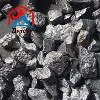
In LF refining, Silicon Carbide Deoxidizer is used not only for oxygen control, but also for slag conditioning. Its practical value lies in reducing oxidizing slag components and helping the slag reach a more workable fluidity range, which improves slag washing efficiency and promotes cleaner steel. Under suitable slag conditions, the reaction products of Silicon Carbide Deoxidizer help the slag spread more effectively, absorb inclusions more efficiently, and support higher molten steel cleanliness.
Why does slag washing matter in LF refining with Silicon Carbide Deoxidizer?
In LF refining, slag washing is the process by which refining slag contacts molten steel, absorbs non-metallic inclusions, and protects the steel from reoxidation. This process only works well when the slag has the right chemical state and the right fluidity.
If the slag is too oxidizing, too stiff, or too viscous, slag washing becomes less effective. The slag cannot renew the slag-metal interface efficiently, and inclusion absorption slows down. Once this happens, the steel may retain more suspended inclusions, and the refining effect becomes unstable.
This is why slag fluidity is not a secondary visual property. It is part of the refining mechanism itself.
How does Silicon Carbide Deoxidizer affect slag behavior in LF refining?
The main reaction is commonly written as:
SiC+3FeO→SiO2+CO+3Fe
This reaction is important in LF refining because it directly reduces FeO in the slag. A slag with lower FeO is generally less oxidizing and more suitable for secondary refining. At the same time, the formation of SiO2 changes the slag chemistry and helps move the slag away from an overly aggressive oxidation state.
In practical LF operation, this means Silicon Carbide Deoxidizer does not only remove oxygen indirectly. It also helps condition the slag into a more effective refining medium.
How can SiO2 improve slag fluidity in LF refining?
This effect must be understood as a slag-balance adjustment, not as an isolated "more SiO2 is always better" rule.
In LF refining, the slag often begins with a composition that may be too oxidizing or too structurally unfavorable for effective slag washing. When Silicon Carbide Deoxidizer reacts and forms SiO2 while reducing FeO, the slag composition shifts. Under the right basicity and refining practice, this shift can improve slag flow behavior by reducing excessive oxidation and moving the slag into a more workable viscosity range.
In practical terms, this can improve:
- slag spreadability over the steel surface
- slag renewal during stirring
- mobility of the slag phase
- contact efficiency between slag and inclusions
So the key point is not SiO2 alone. The key point is that SiC changes the slag from a less effective refining phase into a more workable one.
Why does better slag fluidity improve steel cleanliness?
Cleaner steel depends on efficient inclusion transfer from steel into slag. If slag fluidity is poor, the inclusion-removal path becomes weaker. Inclusions remain suspended longer, and the slag-metal interface becomes less effective.
Once slag fluidity improves, slag washing becomes more efficient. This helps in three ways:
Does it improve inclusion absorption?
Yes. A more fluid slag can capture and dissolve inclusions more effectively.
Does it improve slag-metal interface renewal?
Yes. Better fluidity allows the slag surface to renew more efficiently during LF stirring.
Does it reduce reoxidation risk?
Yes. Lower slag FeO and a more stable slag phase reduce the tendency of the slag to act as an oxidizing source against refined steel.
That is why slag fluidity and steel cleanliness are directly linked in LF practice.
When is Silicon Carbide Deoxidizer most useful for LF slag fluidity control?
Silicon Carbide Deoxidizer is most useful when the LF slag shows:
- high FeO or oxidizing tendency
- poor flowability
- weak slag washing effect
- unstable inclusion absorption
- repeated late-stage correction in refining
In these conditions, SiC helps by reducing oxidizing slag components and supporting a more workable slag condition. The value is highest when the plant is already operating with a clear refining objective and needs the slag to function more effectively rather than simply sit on the steel surface.
What should operators pay attention to when using Silicon Carbide Deoxidizer for LF slag optimization?
The result depends on the whole slag system, not on SiC alone. Operators should pay attention to:
- initial slag oxidation level
- slag basicity
- timing of SiC addition
- stirring intensity
- particle size and consistency of the Silicon Carbide Deoxidizer
If these are not controlled, the slag-conditioning effect becomes less predictable. In this context, ZhenAn supports customers who require specification-based silicon carbide supply for refining applications, where stable size and repeatable furnace response matter as much as nominal chemistry.
What is the practical conclusion for Silicon Carbide Deoxidizer in LF slag washing?
In LF refining, Silicon Carbide Deoxidizer helps optimize slag fluidity by lowering FeO, shifting slag chemistry through reaction products, and improving the slag's ability to function as a refining medium. The practical result is better slag washing, stronger inclusion absorption, and cleaner molten steel. In this application, the value of Silicon Carbide Deoxidizer is not limited to deoxidation. It lies in making the slag work better.
FAQ
Q:Why is slag fluidity important in LF refining with Silicon Carbide Deoxidizer?
A:Because slag fluidity controls slag washing efficiency, inclusion absorption, and the quality of the slag-metal interface.
Q:How does Silicon Carbide Deoxidizer improve LF slag conditions?
A:It reduces FeO in slag and shifts slag chemistry through the formation of SiO2, helping the slag move into a more workable refining state.
Q:Does SiO2 always improve slag fluidity?
A:Not by itself in every system. The benefit comes from overall slag conditioning after SiC reduces oxidizing slag components.
Q:Why does better slag washing improve molten steel cleanliness?
A:Because a more fluid and better-conditioned slag absorbs inclusions more efficiently and reduces reoxidation risk during refining.