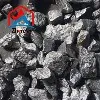
Ferrotitanium 40 carries 35% to 45% titanium and is used for grain refinement, deoxidation and for stabilising carbon and nitrogen in steel. It is not produced by a single process. Three routes dominate industrial supply, and each one leaves a different fingerprint in the analysis, which is why two lots certified to the same grade can behave differently in the ladle. Grades FeTi30, FeTi40 and FeTi70 are specified in GB/T 3282 and in ISO 5454, with the aluminium and silicon limits tightening as the titanium content rises.
Remelting Route
Titanium bearing scrap and steel scrap are melted together in an induction furnace. The iron-titanium system has a comparatively low melting point near 68% titanium, so a charge can be melted at a moderate temperature and poured into ingots or cast into plates. In practice the melt is held near 70% titanium, which is why the remelting route is associated with the richer FeTi70 grade rather than with FeTi40. Titanium burns readily at temperature, so the charge is densified, for example by packing scrap in steel containers and pressing, and the melt is covered with a low melting flux such as a chloride mixture to limit oxidation. Losses still occur, and the resulting analysis reflects both the scrap charge and the extent of oxidation. The same furnace can produce titanium bearing composite alloys by adjusting the charge, which is a useful flexibility where a customer needs a specific titanium to iron ratio.
Electrosilicothermic Reduction
In this route a titania bearing slag or concentrate is reduced by ferrosilicon in an electric furnace, with lime and fluorspar additions controlling slag fluidity and activity. The products are silicon bearing titanium alloys such as Fe-Ti-Si and Si-Ca-Ti, and the process can be extended to multi-element titanium composite alloys by adding further oxides or ferroalloys to the charge. The advantages are continuous operation, low aluminium content in the product and good control of the slag chemistry; the limitation is that silicon remains a significant constituent, so the product is not interchangeable with a low silicon FeTi40 for every application.
| Route | Reductant or charge | Typical titanium content | Characteristic analysis features |
|---|---|---|---|
| Remelting | Titanium and steel scrap | Near 70% Ti in the melt | Carbon from scrap steel, moderate silicon |
| Electrosilicothermic | Ferrosilicon reducing titania slag | Composite Fe-Ti-Si products | Higher silicon, low aluminium |
| Aluminothermic thermit | Aluminium reducing titania | FeTi30 and FeTi40 range | Residual aluminium, low carbon |
Aluminothermic Thermit Reduction
The thermit route reacts titania with aluminium, which reduces the oxide and generates enough heat to keep the reaction self-sustaining. It is the standard way to make the lower titanium grades used in bulk steelmaking, and it produces a low carbon material because no carbon reductant is used. The trade-off is residual aluminium, which is detrimental above certain levels for some steel grades, and a product that must be crushed and screened to the ordered size range. The reaction is exothermic and difficult to control precisely, so producers work to a fixed charge design and a fixed cooling practice to keep the analysis stable from heat to heat.
Melting, Casting and Size Preparation
Ferrotitanium is normally cast into ingots, buttons or plates and then crushed. Crushing introduces oxygen pick-up on fresh surfaces, so the material is screened, de-dusted and packed promptly, and moisture and fines limits are agreed with the buyer. Ferrotitanium 40 is commonly supplied in size ranges such as 10 to 50 mm for bulk charging and finer fractions for cored wire and for additions in the ladle. Fines generate dust and can be lost to oxidation, while oversize material dissolves slowly and delays the heat. Because the alloy is brittle, screen analysis from the actual lot is more useful than a nominal size statement.
Quality Control and Ordering Points
A purchase specification for ferrotitanium 40 should fix the titanium range, the aluminium and silicon maxima, the carbon and nitrogen limits where they matter, the size range with a fines limit, the packing, and the standard basis, either GB/T 3282 or ISO 5454. The certificate of analysis should report measured values for titanium, aluminium and silicon, and the lot should be traceable to the producing heat. Sampling before crushing and after screening answers different questions, so both stages should be recorded when a dispute on size is possible.
Frequently Asked Questions
Q: What is the titanium content of ferrotitanium 40?
A: The designation corresponds to 35% to 45% titanium, with the balance mainly iron and a controlled aluminium and silicon content. FeTi30 covers 25% to 35% titanium and FeTi70 covers 65% to 75% titanium.
Q: Why is aluminium important in ferrotitanium 40?
A: The aluminothermic route leaves residual aluminium in the alloy, and aluminium affects steel cleanliness and the final aluminium specification of the heat. Buyers normally set an aluminium maximum rather than accepting whatever the route produces.
Q: Can ferrotitanium be produced without aluminium or silicon?
A: The remelting route produces the cleanest material in terms of reductant residues, but it operates at a high titanium level near 70% and depends on suitable scrap. Selection therefore depends on the grade needed rather than on a single best process.
Q: Which standard covers ferrotitanium grades?
A: GB/T 3282 specifies ferrotitanium grades and their chemical requirements, and ISO 5454 covers ferrotitanium specifications and conditions of delivery. The order should state which basis applies.
Q: How is recovery affected by the titanium content of the alloy?
A: Higher titanium content means less material is added per unit of titanium, which reduces the mass entering the ladle. Recovery also depends on addition method, temperature and slag practice, so it should be established on the specific steelmaking route.
Q: What size range is used in cored wire?
A: Cored wire normally uses a finer screened fraction with a controlled fines limit, so that the powder flows evenly into the sheath. The exact range should be agreed against the wire filling equipment of the user.