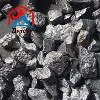
Direct Answer
Metallurgical silicon carbide in the 80%-90% range is a working reducing and alloying material whose value depends on effective silicon and carbon contribution, reaction behavior in the furnace, and overall process cost rather than nominal assay alone. In practical steelmaking and foundry operation, these grades are usually evaluated by recovery, impurity level, particle-size consistency, and suitability for the target melting process.
Why Is 88% SiC Often a Better Alternative to FeSi 75?
In ordinary steelmaking and foundry practice, 88% metallurgical SiC is often a more economical alternative to FeSi 75, provided the process can make effective use of both silicon and carbon. The reason is straightforward. FeSi 75 mainly supplies silicon, while SiC contributes both silicon and carbon in one material. When both elements are useful to the furnace balance, the total alloying cost can often be reduced.
This is the main cost-performance logic behind 88% SiC.
From a plant perspective, 88% SiC often occupies a practical middle position. Lower grades may become less attractive if ash or gangue content is too high, while 90% grade is more often selected where tighter consistency or better energy performance is required. In routine steelmaking and casting applications, however, 88% SiC is frequently the most balanced grade for replacing FeSi 75.
This should not be treated as a universal rule. If the steel chemistry is highly sensitive, or if the process cannot accommodate the carbon input, the selection logic changes. In many standard melting operations, however, the substitution benefit remains strong.
How Should 80%-90% SiC Be Evaluated?
Product selection in this range should not rely only on nominal SiC percentage. The more relevant technical points usually include:
- available silicon
- fixed carbon contribution
- free silica and free carbon level
- ash content
- particle-size consistency
- bulk density
- actual recovery in the target furnace
A nominally higher grade may still underperform if particle-size control is weak or if impurity distribution is unstable. A well-controlled 88% grade may perform more reliably than a higher-grade product with inconsistent physical behavior.
This is why furnace type, addition point, slag condition, and tapping practice all matter when selecting metallurgical SiC.


How Do Grains and Briquettes Behave Differently in the Furnace?
SiC grains and SiC briquettes do not behave in the same way after addition, and the difference is important in practical furnace operation.
Why do grains react faster?
Grains usually react faster because they expose more active surface area and interact more directly with the molten bath or slag-metal interface. In induction furnace and foundry practice, this can be advantageous because the metallurgical response appears more quickly. Under good stirring and controlled oxidation conditions, grains often provide a more immediate and transparent reaction path.
That faster response is useful, but it also requires sizing discipline. If grains are too fine, oxidation loss may increase. If they are too coarse, dissolution and assimilation may become uneven.
Why do briquettes react more slowly?
Briquettes generally react more slowly because the compacted structure delays immediate exposure of reactive surface. In some operating conditions, this slower release is beneficial because it reduces dusting, improves handling, and supports more orderly charging. In bulk addition practice, briquettes may also offer advantages in transport and storage.
The trade-off is reaction speed.
If briquettes are too dense, the release may be slower than the process requires. If compressive strength is too low, breakage during handling can eliminate the expected advantage. The practical choice between grains and briquettes is therefore a choice between faster metallurgical response and more controlled physical handling.
Which Form Is More Suitable?
There is no single answer for every plant. In more controlled furnace environments where a faster reaction is preferred, grains are often more suitable. Where bulk handling stability, reduced dust generation, or more gradual release is important, briquettes may be the better option.
The important point is that the two forms should not be treated as interchangeable.
How Can 90% SiC Help Reduce Energy Consumption?
In one production case, a steelmaking customer using a lower-grade silicon source faced not only alloy-cost pressure, but also excessive electricity consumption caused by repeated late-stage chemistry correction. After changing part of the silicon input to 90% metallurgical SiC with tighter particle-size control, the chemistry adjustment became more stable and fewer corrective additions were required. Because the heat reached the target silicon level more efficiently, the furnace spent less time under holding and correction, which reduced energy consumption.
This type of result is technically credible because it comes from improved process efficiency rather than from nominal chemistry alone.
Why Can Higher-Grade SiC Improve Furnace Efficiency?
90% SiC can reduce energy use when it allows the plant to reach chemistry targets with fewer correction cycles and more stable recovery. Because the material delivers a higher effective silicon-bearing value per unit mass, the furnace may require less repeated adjustment. Where late-stage correction is a major source of energy loss, a shift to a higher and more stable SiC grade can improve the thermal balance of the operation.
This does not mean that every plant should automatically move to 90% SiC. In many ordinary melting operations, 88% SiC remains the more rational choice because it provides the best balance between cost and metallurgical effect. The higher grade becomes more attractive where process stability, recovery, and energy efficiency are under closer control.
How Are 80%-90% SiC Grades Usually Positioned?
In practical use, the grades are often understood in the following way:
80%-85% SiC: suitable where cost pressure is strong and the application can tolerate a higher impurity burden
88% SiC: often the best cost-performance point for ordinary steelmaking and foundry use, especially as an alternative to FeSi 75
90% SiC: more suitable where the plant requires better consistency, stronger recovery, or reduced correction-related energy consumption
This is a practical production view rather than a purely laboratory classification.
What Is the Most Useful Technical Recommendation?
The most reliable selection principle is to evaluate metallurgical SiC by furnace result rather than assay alone. In ordinary steelmaking and foundry use, 88% SiC is often the most effective replacement for FeSi 75 because it combines reasonable cost with useful silicon and carbon contribution. Where faster reaction is required, grains are usually preferred if sizing is well controlled. Where handling convenience and more gradual release are more important, briquettes should be evaluated carefully. Where the real production problem is repeated chemistry correction and high electricity consumption, 90% SiC often becomes the more efficient choice.
In practical metallurgy, 80%-90% silicon carbide should be treated not as a catalog number, but as a furnace tool whose value depends on how it performs under real operating conditions.
FAQ
Q1: What is the role of 90% Silicon Carbide in steelmaking?
A1:SiC 90% serves as a dual-purpose additive: a high-efficiency deoxidizer and a cost-effective recurburizer. Its exothermic reaction during deoxidation reduces energy consumption and improves slag fluidity in ladle furnaces.
Q2: Can SiC 88% replace Ferrosilicon (FeSi 75)?
A2:Yes. Metallurgical SiC 88% is a reliable substitute for Ferrosilicon in standard carbon steel and foundry applications. It offers higher silicon recovery rates and lower total alloy costs per ton compared to bulk ferrosilicon.
Q3: When to use SiC Briquettes vs. SiC Grains?
A3:SiC Briquettes are ideal for cupolas and induction furnaces due to their high density and deep melt penetration. SiC Grains (0-10mm) are better for rapid deoxidation when added directly to the ladle during tapping.
Q4: How does density affect Silicon Carbide recovery?
A4:Higher bulk density in Silicon Carbide for steelmaking ensures the material passes through the slag layer to react directly with the molten steel, maximizing the silicon recovery rate and minimizing material waste.
Q5: Are impurities controlled in SiC grades below 90%?
A5:High-quality Metallurgical SiC (80-90% grades) maintains strict impurity controls, keeping Phosphorus (P) and Sulfur (S) below 0.05%. This prevents brittleness and ensures the mechanical toughness of the final steel product.
Q6:Where can I get the latest silicon carbide price?
A6:Silicon carbide prices change frequently depending on market conditions, specifications, and order quantity. It is recommended to contact suppliers directly for real-time quotations.📩 sale@zanewmetal.com