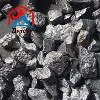
The core conclusion is that silicon is a metalloid, possessing properties of both metals and nonmetals. While it lacks the full conductivity of a true metal, its semiconductor nature makes it the foundation of modern electronics. In the 2026 metallurgical industry, silicon's unique properties are most effectively utilized in the form of Silicon Carbide 88 90 Deoxidizer, which offers a dual-action benefit of deoxidation and recarburization, significantly outperforming traditional metallic alloys in efficiency and cost.
1. The Hidden Connection: Silicon Carbide and Battery Cells
To answer the question "Is silicon a metal, nonmetal, or metalloid?", one must look at its position on the periodic table. Silicon (Si) is classified as a metalloid. It sits on the "staircase" line that separates metals from nonmetals.
As a metalloid, silicon is a "chameleon" of the chemical world:
- Metallic Properties: It has a blue-grey metallic luster and a high melting point (1414℃).
- Nonmetallic Properties: It is brittle and is not a good conductor of electricity at room temperature.
- The Semiconductor Advantage: Unlike metals, whose conductivity decreases as temperature rises, silicon becomes more conductive when heated. This unique metalloid trait is what allows it to be processed into everything from computer chips to high-performance Silicon Carbide 88 90 Deoxidizer for heavy industry.
2. From Element to Alloy: The Rise of Silicon Carbide (SiC)
Understanding that silicon is a metalloid explains why it is rarely used in its pure form in heavy industry. Instead, it is combined with carbon to create Silicon Carbide (SiC). In 2026, the global metallurgical market has shifted its focus toward the Silicon Carbide 88 90 Deoxidizer as the premier solution for steelmaking.
While pure silicon is a metalloid, Silicon Carbide 88 90 Deoxidizer behaves like a precision chemical reagent in a furnace. By smelting quartz sand (silicon source) and petroleum coke (carbon source) at temperatures above 2000℃, we create a material that possesses diamond-like hardness and incredible thermal stability.

3. Why Silicon Carbide 88 90 Deoxidizer Outperforms Traditional Metals
In traditional steelmaking, Ferrosilicon (a metallic alloy) was the standard. However, because silicon is a metalloid, its reaction with oxygen is far more efficient when delivered via Silicon Carbide 88 90 Deoxidizer.
Table 1: Silicon Carbide 88 90 Deoxidizer vs. Metallic Ferrosilicon
| Comparison Metric | Traditional Ferrosilicon (FeSi 75) | Silicon Carbide 88 90 Deoxidizer |
| Material Class | Metal Alloy | Advanced Metalloid Ceramic |
| Primary Function | Silicon Supplement | Deoxidation + Recarburization |
| Thermal Energy | Endothermic (Absorbs Heat) | Strongly Exothermic (Adds Heat) |
| Cost Efficiency | High Market Volatility | 15-20% Total Cost Savings |
| Slag Formation | High Residue | Minimal, Fluid Slag |
4. Industry Applications of "Sub-90" Silicon Carbide
The Silicon Carbide 88 90 Deoxidizer is the "sweet spot" for industrial applications. While 98% purity SiC is used for semiconductors, the 88% and 90% grades are designed specifically for the rigorous environment of the foundry.
- Electric Arc Furnaces (EAF): The Silicon Carbide 88 90 Deoxidizer provides the chemical energy needed to maintain melt temperature while cleaning the steel of impurities.
- Iron Foundries: It acts as a powerful inoculant, helping silicon (the metalloid) integrate into the iron lattice to improve the strength and machinability of the final casting.
- Converter Operations: When used in briquette form, the Silicon Carbide 88 90 Deoxidizer can penetrate the slag layer effectively, ensuring that the metalloid reaches the molten metal without being wasted as dust.
5. FAQ: Expert Insights for Procurement Managers
Q1: Since silicon is a metalloid, does it rust like a metal?
A1: No. Silicon forms a protective silicon dioxide layer when exposed to air, making it extremely resistant to corrosion. This is why Silicon Carbide 88 90 Deoxidizer is so stable during transoceanic shipping and long-term storage in damp warehouses.
Q2: Why is the 88 90 grade preferred over higher purity metalloid silicon?
A1: Cost-effectiveness. For deoxidation, 99% purity is unnecessary. The Silicon Carbide 88 90 Deoxidizer provides exactly what the furnace needs-silicon for deoxidation and carbon for recarburization-at a fraction of the price of high-purity alternatives.
Q3: How do I verify the quality of a Silicon Carbide 88 90 Deoxidizer shipment?
A1: Look for the characteristic crystalline luster and ensure the material is free of excessive dust. At ZhenAn, we provide full chemical analysis for every batch of Silicon Carbide 88 90 Deoxidizer, focusing on stable SiC content and low impurities (Al/S/P).

One-Stop Metallurgical Material Factory In China
Click "Send Inquiry Now" to receive the latest March 2026 price list for our Silicon Carbide 88 90 Deoxidizer.