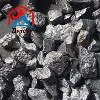
High-quality silicon carbide for casting should have stable particle size distribution, high SiC purity, low impurity content (Fe, SiO₂), and good thermal performance to ensure consistent casting results and reduced defects.
What Is Silicon Carbide and Why Does Grain Size Matter in Casting?
Silicon carbide (SiC) is a high-performance refractory and additive material, and its grain size directly affects melting efficiency, reaction rate, and casting quality.
In casting applications, SiC is used for:
- Deoxidation
- Increasing carbon content
- Improving thermal conductivity
Grain size impacts:
- Reaction speed
- Dissolution rate
- Uniformity in molten metal
Common sizes:
- 0–1mm: Fast reaction, quick absorption
- 1–5mm: Slower reaction, more stable performance

How Does Particle Size Distribution Affect Casting Performance?
A uniform particle size distribution ensures consistent melting behavior and prevents segregation or uneven reactions in molten metal.
Key indicators:
- Narrow size tolerance (avoid too much powder or oversized particles)
- Minimal dust content
- No excessive fines
👉 Poor grading can lead to:
- Material loss
- Inconsistent chemistry
- Increased slag formation
What Purity Level Indicates High-Quality Silicon Carbide?
High-quality silicon carbide typically has SiC content above 90%–98%, with minimal impurities such as Fe₂O₃ and SiO₂.
Recommended specs:
SiC: ≥90% (casting grade)
Fe₂O₃: ≤1.5%
SiO₂: ≤2.5%
Higher purity means:
- Better recovery rate
- Less contamination
- Improved casting stability
How Do Impurities Affect Casting Results?
Excess impurities reduce efficiency and can introduce defects such as inclusions or poor mechanical properties.
Critical impurities:
- Iron (Fe): Alters composition
- Silica (SiO₂): Forms slag
- Free carbon: Affects control
👉 High impurity = lower yield + more defects
What Physical Properties Should You Check Before Buying?
Key physical properties include density, hardness, and thermal stability, which determine how SiC performs under high-temperature casting conditions.
Important parameters:
- Bulk density
- Hardness (Mohs ~9)
- Thermal conductivity
- Oxidation resistance
Which Grain Size Is Better: 0–1mm or 1–5mm?
0–1mm is better for fast reaction and quick absorption, while 1–5mm provides more controlled and stable performance in casting.
Selection guide:
| Application | Recommended Size |
|---|---|
| Rapid adjustment | 0–1mm |
| Stable melting | 1–5mm |
| Precision casting | Mixed grading |
How to Visually Identify High-Quality Silicon Carbide?
High-quality SiC should appear dark black, with uniform particles, minimal dust, and no visible contamination.
Visual checklist:
✔ Bright black color
✔ Uniform size
✔ No excessive powder
✔ No foreign particles
How to Choose a Reliable Silicon Carbide Supplier?
Choose suppliers that provide stable quality, COA certification, and consistent particle sizing with reliable delivery.
Key factors:
✔ COA (Certificate of Analysis)
✔ Consistent grain size
✔ MOQ: typically 1 ton
✔ Delivery time: around 15 days
Prices fluctuate, so provide:
- Size (0–1mm / 1–5mm)
- Quantity
- Destination port

What Are Common Problems Caused by Low-Quality SiC?
Low-quality silicon carbide can lead to unstable reactions, increased slag, poor recovery, and casting defects.
Typical issues:
- Inconsistent composition
- Low absorption rate
- High material loss
- Increased production cost
Get High-Quality Silicon Carbide for Casting
To ensure optimal casting performance, selecting the right SiC grade and supplier is essential.
📩 Contact us to:
- Get latest price
- Request COA
- Receive expert recommendations
FAQ
Q:What is the best grain size of silicon carbide for casting?
A:It depends on the application. 0–1mm is suitable for fast reaction, while 1–5mm offers more stable and controlled performance.
Q:What purity of silicon carbide is required for casting?
A:Typically, SiC content above 90% is acceptable, while higher purity (95%+) provides better efficiency and fewer impurities.
Q:Why is particle size important in silicon carbide?
A:Particle size affects reaction speed, absorption efficiency, and uniformity in molten metal, directly impacting casting quality.
Q:How can I check silicon carbide quality before buying?
A:Check COA, verify particle size distribution, inspect visually, and confirm impurity levels.
Q:Does finer silicon carbide react faster?
A:Yes, smaller particles (0–1mm) react faster due to larger surface area, improving absorption speed.