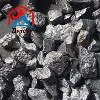
Silicon metal is supplied as a crushed solid whose value depends as much on physical form and trace chemistry as on headline silicon content. Particle size controls melting and dissolution behaviour in the customer's furnace, while iron, aluminium and calcium set the ceiling on what a downstream melt can tolerate. Both are specified, both are measured, and both are purchased with the material.
How Particle Size Drives Process Behaviour
Particle size affects melting rate, melt homogeneity and energy consumption in downstream operations. Three broad size classes cover most industrial demand:
| Size class | Behaviour in the melt | Typical duty |
|---|---|---|
| Coarse, above 1 mm | Slow, gradual dissolution; higher energy demand per unit dissolved | Long-process metallurgy such as steel deoxidation where gradual pickup is acceptable |
| Medium, 0.5 to 1.0 mm | Balances melt uniformity with furnace throughput | Aluminium alloy production |
| Fine, below 0.5 mm | Rapid reaction kinetics and tight stoichiometric control, but greater oxidation and dust loss | Chemical synthesis and high-purity routes |
A practical purchase specification should state both a top size and a fines limit, and should name the sieve series used to determine them. Shipping a single nominal size without a fines ceiling is the most common cause of disputes on received lots.
Why Iron, Aluminium and Calcium Are Controlled
Iron (Fe): above roughly 0.5% it degrades electrical behaviour in semiconductor-grade duty and reduces mechanical performance in aluminium alloys, where iron-rich phases embrittle the cast structure.
Aluminium (Al): above roughly 0.3% it can promote intergranular attack in high-temperature alloys and reduce refractory stability in aggressive melts.
Calcium (Ca): even trace calcium can trigger slag formation in steelmaking and increase refining cost, so low-calcium grades are selected wherever slag control is critical.
Reading an Industrial Silicon Grade Code
Chinese industrial silicon grades encode three successive impurity ceilings rather than a single silicon figure. In the four-digit form, 5530 corresponds to Fe 0.5%, Al 0.5% and Ca 0.30%; 4410 corresponds to Fe 0.4%, Al 0.4% and Ca 0.10%; and 3303 corresponds to Fe 0.3%, Al 0.3% and Ca 0.03%. The short forms 553, 441 and 3303 that appear in trading documents follow the same iron, aluminium, calcium sequence, so a buyer should always confirm the calcium bracket on the certificate of analysis rather than inferring it from the grade name. Limits should be checked against the product standard in force, GB/T 2881 for industrial silicon, and against the actual lot results.
Impurity Effects by Downstream Sector
| Application | Most critical element | Consequence if exceeded | Usual control |
|---|---|---|---|
| Aluminium alloys | Fe | Reduced ductility and electrical conductivity | Tighter iron bracket such as 4410 |
| Steel deoxidation | Ca | Slag formation and higher refining cost | Low-calcium grades |
| Chemical synthesis | Al and Ca | Catalyst interference and colour variation | 3303 class material |
| High-temperature alloys | Al | Intergranular corrosion and refractory wear | Low-aluminium specification |
| Semiconductor and electronics | All three | Loss of electrical performance | Tightest available brackets plus lot testing |
Control Points From Specification to Receipt
Write the particle size band, the sieve series and the Fe, Al and Ca ceilings into the specification, not just the silicon content.
Sample each lot and prepare the sample following the sampling clause of the applicable product standard, then have the material tested by the named referee laboratory.
Screen the delivered material rather than relying on the mill certificate alone, since handling and transport generate fines.
Store under cover and keep lots dry; fines oxidise and pick up moisture faster than lump material and change the effective chemistry of the charge.
Match the size class to the process: medium material for alloy melting, controlled fines for chemical routes, coarse lumps for slow deoxidation duty.
Frequently Asked Questions
Q: What particle size of silicon metal is best for aluminium alloying?
Medium material in the 0.5 to 1.0 mm band is the usual choice because it dissolves evenly while still allowing good furnace throughput.
Q: Why does iron content matter so much?
Iron above roughly 0.5% introduces brittle intermetallic phases in aluminium alloys and degrades electrical performance in electronic grades.
Q: What does the grade 3303 mean?
It denotes Fe 0.3%, Al 0.3% and Ca 0.03%, so it is a low-calcium material suited to chemical synthesis and slag-sensitive melts.
Q: Is finer silicon always better for reaction speed?
No. Fines react quickly but oxidise, generate dust and can raise aluminium pickup, so the size class should be matched to the actual process rather than minimised.
Q: How is particle size verified on delivery?
By sieve analysis of a representative sample taken and prepared under the sampling clause of the applicable product standard, with the result recorded against the lot number.
Q: Does calcium really matter at trace levels?
Yes. Small calcium contents can destabilise slag in steelmaking, so the calcium bracket should be specified explicitly whenever slag control or clean steel is the objective.
Q: Can one grade serve several applications?
It can, but the cost of over-specifying iron or aluminium is usually lower than the cost of a rejected cast or a failed chemical batch.