Apr 02, 2026 Leave a message

Pure Grains vs. Bonded Briquettes: Which Silicon Carbide Form Is Better

Direct Answer

For steelmaking, pure grain-form Silicon Carbide Deoxidizer is usually the better choice when the goal is faster reaction, cleaner chemistry input, and more predictable furnace performance. Bonded briquettes can improve physical handling in some charging systems, but the binder adds a non-active phase, delays the initial reaction, and makes impurity control less transparent. In practical furnace use, the better form is not the one that looks easier to store. It is the one that delivers the intended metallurgical effect with the fewest extra variables.


Why does binder content matter in Silicon Carbide Deoxidizer selection?

Binder is not metallurgically neutral. Once a briquette enters the furnace, the plant is no longer charging only silicon carbide. It is charging silicon carbide plus the material required to hold the briquette together.

That matters because the binder can:

  • introduce non-active material into the heat
  • alter how the briquette opens in the slag-metal system
  • change the reaction timing of the active SiC
  • make impurity evaluation less direct

This is why many professional buyers treat binder as a process variable, not merely a forming aid. In routine bulk handling, that variable may be acceptable. In steel plants trying to control oxygen removal and alloy response tightly, it often becomes a disadvantage.


How do pure Silicon Carbide Deoxidizer grains react differently from bonded briquettes?


The main difference is how quickly active surface becomes available.

Why do grain-form Silicon Carbide Deoxidizers react faster?

Pure grains usually react faster because they expose more active surface directly to the slag-metal system as soon as they are charged. This means the furnace sees the material immediately rather than waiting for a compact structure to open.

That faster exposure usually gives:

  • quicker deoxidation response
  • more direct FeO reduction behavior
  • easier observation of furnace effect
  • less delay in chemistry correction

Why do bonded Silicon Carbide Deoxidizer briquettes react more slowly?

Briquettes react more slowly because their compact structure delays the immediate contact between active SiC and the molten environment. Before the full reaction can occur, the briquette must first break down or open under furnace conditions.

This delay is not always unacceptable, but it becomes important in operations where the timing of alloy effect affects total holding time, slag condition, or late-stage corrections.


Why does specific surface area matter in Silicon Carbide Deoxidizer performance?


Specific surface area is one of the main reasons grains outperform briquettes in direct furnace response. More exposed surface means more immediate interaction with the active metallurgical environment.

In practical deoxidation, higher accessible surface area generally improves:

  • reaction speed
  • contact efficiency with oxidizing slag components
  • uniformity of response
  • predictability of alloy effect

This does not mean the smallest possible material is always best. Extremely fine material can increase dust loss and oxidation before assimilation. The advantage of grains is not simply that they are smaller. It is that they offer exposed active material without depending on a compact body to open first.

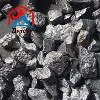
Grain-Form Silicon Carbide Deoxidizer
grain-form Silicon Carbide Deoxidizer
Silicon Carbide Deoxidizer Briquettes

Why do professional steel plants return to grain-form Silicon Carbide Deoxidizer?


Many plants move back to grains after finding that briquettes solve a handling problem while creating a furnace-response problem.

Is chemistry more transparent with grain-form Silicon Carbide Deoxidizer?

Yes. With pure grains, the buyer is evaluating the actual active material, not a formed product whose behavior is also influenced by binder ratio and briquetting quality.

Is furnace response easier to interpret with grain-form Silicon Carbide Deoxidizer?

Yes. Grains usually provide a more direct and faster reaction, which helps the operator understand the effect of the addition more clearly.

Is impurity control easier with grain-form Silicon Carbide Deoxidizer?

Usually yes. Since grains avoid the extra binder phase, the chemical picture is simpler and easier to verify.

This is why many professional steel plants return to grains after initially using briquettes for convenience.


When can bonded Silicon Carbide Deoxidizer briquettes still make sense?

Bonded briquettes still have a role in some conditions. They may be useful where the plant values:

  • reduced dust during handling
  • easier storage and charging in bulk systems
  • slower and more gradual material release
  • improved transport stability in certain supply chains

These are real advantages, but they are mostly logistical rather than metallurgical. The plant must decide whether those physical benefits justify slower reaction and less transparent chemistry.


How should buyers compare different Silicon Carbide Deoxidizer forms?

The comparison should be made through furnace behavior, not product appearance.

Buyers should compare:

  • reaction speed in the target furnace
  • binder content and binder consistency
  • actual recovery in the process
  • dust loss during charging
  • batch-to-batch repeatability

whether the plant values metallurgical directness or physical convenience more

In this context, ZhenAn supports customers who require specification-based Silicon Carbide Deoxidizer supply matched to real furnace practice, which is especially relevant when form selection changes the practical result as much as chemistry does.


What is the practical conclusion for Silicon Carbide Deoxidizer form selection?

Pure grain-form Silicon Carbide Deoxidizer is usually the better form when the steel plant wants faster reaction, cleaner chemistry input, and more predictable metallurgical response. Bonded briquettes can still be useful in some handling systems, but they add binder-related uncertainty and delay the initial active reaction. For steel plants focused on actual furnace performance rather than packaging convenience alone, grains are often the more reliable choice.


Get A Quote Now


FAQ


Q:Why is grain-form Silicon Carbide Deoxidizer usually preferred in steelmaking?

A:Because it reacts faster, contains no binder, and provides more direct furnace response.

Q:Do bonded Silicon Carbide Deoxidizer briquettes always perform worse?

A:Not always. They can help in some handling systems, but their compact form usually delays the initial reaction.

Q:Why is binder considered a disadvantage in Silicon Carbide Deoxidizer briquettes?

A:Because it adds non-active material, affects how the product opens in the furnace, and reduces chemistry transparency.

Q:What is the main reason many steel plants return to grain-form Silicon Carbide Deoxidizer?

A:The main reason is more predictable metallurgical behavior and easier control of reaction timing.


Send Inquiry

Home

Phone

E-mail

Inquiry