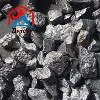
Medium carbon ferromanganese Refined ferromanganese (ΦMн0.5, ΦMн1.0A, ΦMн1.0 and ΦM1.5) is produced by reducing the oxides in manganese ore and manganese-rich slag with silicon in silicon-manganese alloy and adding lime at the same time. Lime and silica combine to form silicate, and the reaction is as follows:
2MnO+MnSi+2CaO=3Mn+2CaO·SiO2
ΔZ°=-27673-0.935T
3MnO+MnSi+CaO=3Mn+1/2(2MaO·SiO2)+1/2(2CaO·SiO2)
ΔZ°=-10508-3.61T
2 1/2MoO+MaSi+CaO=3Ma+1/2(MaO·SiO3)+1/2(2CaO·SiO2)
ΔZ°=-31336+10.77T
2MnO·SiO2+MnSi+4CaO=3Mn+2(2CaO·SiO2)
ΔZ°=-56378+1.19T
2(MnO·SiO2)+MnSi+6CaO=3Mn+3(2CaO·SiO2)
ΔZ°=-86585-2.48T

Smelting is carried out in a tiltable rotary electric furnace with a power of 2500 to 3500 kVA. Magnesia furnace lining, working voltage is 130~280 volts. Raw materials include liquid or lump manganese-rich slag (Mn>47% and P0.011~0.017%), manganese concentrate, silicon-manganese alloy ((Si≥19%, C≤1.0% and P≤0.30%), particle size less than 30mm) and lime (CaO ≥ 90%, particle size less than 50mm). If the furnace charge is not equipped with manganese-rich slag, the carbon content of silicon-manganese alloy should be less than 0.8%, and the ore should be dried until the moisture is 1 to 3%.

The smelting process is cyclical and is divided into several stages: repairing the furnace, returning slag to strike the arc, loading solid materials, melting the charge and adjusting the composition, and tapping the iron. The composition of the material batch is as follows: 100 kilograms of manganese-rich slag, 25 to 35 kilograms of manganese concentrate, 45 to 55 kilograms of silicon-manganese alloy and 65 to 70 kilograms of lime.

When smelting medium carbon ferromanganese, manganese-rich slag is generally not included in the charge. First, add lime and alloy fragments produced during finishing into the furnace. After the arc is struck, the charge is loaded. As the charge melts, the surrounding charge is pushed to the vicinity of the electrode. One hundred kilograms of manganese ore and manganese-rich slag consumes 100 to 110 degrees of electricity. One furnace contains 7500-8000 kg of manganese-rich slag, 3700-4000 kg of manganese ore, 7300-7500 kg of lime and 5400-6000 kg of silicon-manganese alloy.

When igniting the arc and melting the charge, the voltage is 276 to 254 volts; when refining and adjusting the ingredients, the voltage is 232 volts. Since the voltage is relatively high, it can only be an arc exposure process. A large amount of liquid slag in the furnace can help stabilize the arc, thereby reducing the carbon content of the alloy by 30 to 35% compared with solid materials. In order to speed up the refining process, compressed air can be used to stir once or twice in each furnace. As the refining time is extended, the silicon content of the alloy decreases.

The end point of smelting is judged based on the external characteristics of the alloy sample. When the silicon content is less than 2%, the cross section of the sample after cooling will have a fine-grained structure and become dark; when the silicon content is greater than 2%, the cross section will be glassy. If the silicon content is high, lime and ore need to be added to continue refining; if the silicon content is low, silicon-manganese alloy needs to be added.

The alloy is produced in a molten iron ladle lined with slag from the previous furnace. The alloy is then poured into a belt caster or ingot mould. The slag is poured into ingot molds or refining equipment. The composition of the slag is as follows: MnO30%, SiO231%, CaO33%, MgO2.0%, Al2O32.1% and FeO0.8%.

At 1320°C, the viscosity of the slag is about 24 poise, which drops sharply to 3 poise at 1400°C, and to about 1 poise at 1650°C. The conductivity of the slag fluctuates between 50 and 400 ohms/meter within the smelting temperature, and should drop sharply as the temperature and manganous oxide content decrease (replaced by calcium oxide). As the MgO content increases, the viscosity of the slag decreases and the conductivity increases.
In recent years, many plans have been proposed to reform the ferromanganese refining process, such as mixing a melt of ore and lime containing 25-50% manganese at a temperature of 1350°C to 1800°C, and medium-carbon ferromanganese into a tuyere equipped with a tuyere at the bottom. into the bag, and mix the liquid silicon-manganese alloy into the bucket, add some lime if necessary, and blow gas (N2, CO, CO2) into the melt through the air nozzle for stirring. Stop supplying air after the ingredients are qualified. The composition of alloys fluctuates with the quality of ingredients and raw materials.