What Is Ferrosilicon?
Ferrosilicon (FeSi) is an iron-silicon alloy produced by reducing silica with carbonaceous materials in a submerged arc furnace. It is primarily used in steelmaking as a deoxidizer and silicon alloying additive. It also serves as a silicon source in cast iron production, magnesium smelting and other metallurgical processes.
Commercial grades include FeSi45, FeSi65, FeSi72 and FeSi75. Depending on the production process and application, ferrosilicon is supplied as lumps, granules, powder or briquettes.
The selection of ferrosilicon depends on more than its nominal silicon content. Chemical composition, impurity limits, particle size, addition method and silicon recovery all affect its performance in the production process. Understanding these factors helps steelmakers, foundries and metallurgical buyers select the appropriate grade and material form.
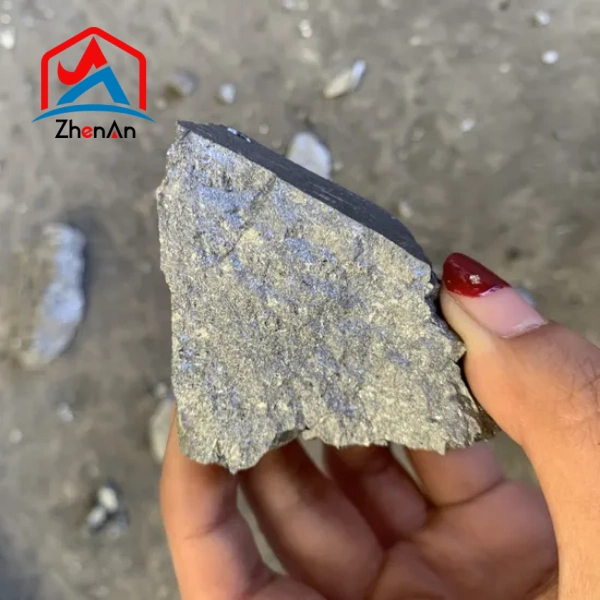
Table of Contents
- Chemical Composition and Grades of Ferrosilicon
- How Is Ferrosilicon Produced?
- Why Is Ferrosilicon Used in Steelmaking?
- Industrial Applications of Ferrosilicon
- Ferrosilicon Forms and Particle Sizes
- How to Calculate Ferrosilicon Addition
- Ferrosilicon Quality Inspection and Storage
- Frequently Asked Questions
Chemical Composition and Grades of Ferrosilicon
The main components of ferrosilicon are silicon and iron. Its commercial grade is identified primarily by the nominal silicon content, while aluminium, calcium, carbon, phosphorus and sulphur are controlled according to the applicable product specification.
Different silicon contents affect the amount of alloy required to achieve a target silicon level in molten steel. A higher-silicon grade generally supplies more silicon per tonne of alloy, whereas a lower-silicon grade may be selected when the process requires a different reduction or alloying balance.
| Grade | Nominal Si Content | Typical Applications | Key Purchasing Considerations |
|---|---|---|---|
| FeSi45 | 45% | Selected metallurgical reduction and alloying applications | Silicon recovery, iron content and impurity limits |
| FeSi65 | 65% | Steelmaking and foundry applications | Si content, Al limits and addition efficiency |
| FeSi72 | 72% | General steelmaking deoxidation and alloying | Actual Si recovery and chemical consistency |
| FeSi75 | 75% | Steelmaking, alloying and magnesium reduction | Si specification, impurities and particle size |
Note: The figures above represent nominal grade designations, not guaranteed complete chemical specifications. Actual Si ranges and impurity limits must be confirmed against the applicable standard, purchase agreement and batch Certificate of Analysis (COA).
Which Chemical Elements Should Buyers Check?
Silicon is the principal specification, but the other elements can affect the suitability of ferrosilicon for a particular steel grade or metallurgical process.
- Silicon (Si): Determines the amount of silicon supplied per tonne of alloy.
- Aluminium (Al): Can affect deoxidation practice, inclusion characteristics and the final steel chemistry.
- Calcium (Ca): May influence inclusion modification and is particularly relevant when comparing specially controlled grades.
- Carbon (C): Should be controlled according to the carbon limit of the target steel.
- Phosphorus (P) and Sulphur (S): Need attention when producing steels with strict residual impurity limits.
- Manganese (Mn) and Chromium (Cr): Should also be checked where the customer's chemical specification requires limits for these elements.
A buyer should not select a grade based only on its Si percentage. The complete chemical analysis should be compared with the requirements of the final steel or alloy.
How Is Ferrosilicon Produced?
Ferrosilicon is generally produced through carbothermic reduction in a submerged arc furnace. Silica supplies silicon, carbonaceous materials act as reducing agents, and iron-bearing materials provide the iron component of the alloy.
The simplified overall reduction reaction is:
SiO₂ + 2C → Si + 2CO
Simplified overall reaction for silica reduction
In an industrial furnace, the actual reaction pathway involves intermediate silicon monoxide and silicon carbide reactions. The final silicon combines with iron to form ferrosilicon.
Main Production Stages
- Raw Material Preparation: Quartz or other suitable silica materials, carbon reductants and iron-bearing materials are selected and checked for chemical composition and physical quality.
- Batching and Mixing: Raw materials are weighed according to the production recipe and mixed to obtain a consistent furnace charge.
- Submerged Arc Furnace Smelting: Electrical energy generates the high temperatures required for silica reduction and alloy formation.
- Tapping and Casting: The molten ferrosilicon is tapped from the furnace and cast into suitable molds or cooling areas.
- Crushing and Screening: The solidified alloy is processed into the required lump, granular or powder size fractions.
- Quality Inspection: Chemical composition, particle size and product appearance are checked before packaging.
Raw material quality directly affects furnace operation and final alloy chemistry. Quartz purity, fixed carbon content, moisture, particle size and the composition of iron-bearing materials all need to be considered when controlling the production process.
Why Is Ferrosilicon Used in Steelmaking?
The principal reason steelmakers use ferrosilicon is the chemical affinity between silicon and oxygen. During steel refining, dissolved oxygen must be controlled to achieve the required steel chemistry and cleanliness.
1. Deoxidation of Molten Steel
When ferrosilicon is added to molten steel, silicon reacts with dissolved oxygen to form silica:
[Si] + 2[O] → SiO₂
Simplified deoxidation reaction in molten steel
The resulting oxide products can enter the slag or be removed through appropriate refining and inclusion-control practices. Actual deoxidation performance depends on temperature, slag chemistry, addition sequence, mixing and the presence of other deoxidizers such as aluminium.
2. Silicon Alloying
Ferrosilicon also supplies silicon as an intentional alloying element. The target silicon level depends on the steel grade and its required mechanical and physical properties.
For example, silicon-bearing electrical steels use controlled silicon additions to increase electrical resistivity and reduce eddy-current losses in transformer and motor cores. Silicon is also specified in certain spring steels, structural steels and other alloy steel grades.
3. Control of Alloy Recovery
The amount of silicon retained in steel is not necessarily equal to the amount introduced through the alloy. Some silicon is consumed during deoxidation or lost through oxidation and other process reactions.
For this reason, steelmakers calculate additions using the target composition, initial steel analysis, actual alloy chemistry and expected recovery rate rather than relying on a fixed dosage for every heat.
Industrial Applications of Ferrosilicon
Although steelmaking accounts for a major share of ferrosilicon consumption, its role differs across metallurgical processes. The following applications require different chemical specifications and physical forms.
1. Steelmaking
Steel producers use ferrosilicon for ladle deoxidation and silicon alloying. The selected grade depends on the steel chemistry, deoxidation sequence and required silicon recovery. Lump material is commonly used for furnace or ladle additions, with particle size selected to suit the charging method.
2. Cast Iron Production
Silicon is an important element in cast iron production because it promotes graphitization and influences the balance between graphite and carbide formation. Ferrosilicon supplies silicon during iron treatment and can contribute to the adjustment of the final chemical composition.
For inoculation, foundries commonly use specially formulated ferrosilicon-based inoculants with controlled active elements and particle sizes. Ordinary bulk FeSi should not automatically be treated as equivalent to a dedicated inoculant grade.
3. Magnesium Production
In the Pidgeon process, ferrosilicon is used as a reducing agent to produce magnesium from calcined dolomite under high-temperature vacuum conditions. Silicon reacts with magnesium oxide, allowing magnesium vapor to form and subsequently condense.
The process requires careful control of the dolomite-to-ferrosilicon ratio, raw material quality, temperature and vacuum conditions. Higher-silicon ferrosilicon is commonly selected for this application, subject to the operating process specification.
4. Dense Medium Separation
Ground ferrosilicon powder is used to prepare dense-medium suspensions in coal washing and mineral processing. The suspended particles increase the density of the medium, allowing separation of materials according to their density differences.
For this application, buyers should evaluate the full particle size distribution, magnetic properties, apparent density and recovery characteristics. A powder specification designed for dense-medium separation is not necessarily suitable for welding or other metallurgical applications.
Ferrosilicon Forms and Particle Sizes
Ferrosilicon is processed into different physical forms to match furnace charging systems, feeding equipment and downstream applications. Particle size influences dissolution, handling, dust generation and material recovery.
| Physical Form | Typical Size Options | Common Applications | Purchasing Considerations |
|---|---|---|---|
| Lumps | 10–50 mm, 10–100 mm | Furnace and ladle additions | Oversize, undersize and fines tolerance |
| Granules | 1–3 mm, 3–8 mm | Controlled feeding and foundry applications | Screen analysis and particle consistency |
| Powder | 200 mesh, 325 mesh and customized sizes | Dense-medium separation and selected metallurgical applications | Particle size distribution, moisture and dust control |
| Briquettes | Customized dimensions | Controlled charging and utilization of processed fines | Strength, dimensions and handling durability |
The same grade of ferrosilicon can be supplied in different physical forms, but the appropriate form depends on the application. For example, large lumps may be suitable for bulk furnace charging, whereas fine powder is specified by its particle size distribution rather than by lump dimensions.
For product specifications, available grades and processing options, see our Ferrosilicon Product Range.
How to Calculate Ferrosilicon Addition
Ferrosilicon consumption in steelmaking depends on the amount of silicon that must be added to the molten steel and the expected silicon recovery. A calculation based only on the nominal grade can underestimate the required addition if process losses are ignored.
Ferrosilicon Addition Formula
Ferrosilicon Addition (kg)
= Steel Weight × Required Si Increase
÷ (Si Fraction in FeSi × Silicon Recovery)
Where:
- Steel Weight: Mass of molten steel in kilograms.
- Required Si Increase: Target silicon content minus initial silicon content, expressed as a decimal fraction.
- Si Fraction in FeSi: Actual silicon content of the purchased alloy, expressed as a decimal fraction.
- Silicon Recovery: Expected proportion of added silicon retained in the steel, expressed as a decimal fraction.
Calculation Example
Assume a steelmaking heat has the following conditions:
| Molten steel weight | 1,000 kg |
| Initial silicon content | 0.10% |
| Target silicon content | 0.20% |
| Ferrosilicon grade | FeSi75 |
| Assumed silicon recovery | 90% |
The required silicon increase is 0.10 percentage points, or 0.001 as a decimal fraction.
Calculation:
1,000 × 0.001 ÷ (0.75 × 0.90)
= 1.48 kg FeSi75
Therefore, approximately 1.48 kg of FeSi75 would be required to achieve the specified silicon increase under these assumed conditions.
Important: This is a simplified silicon-alloying calculation. It does not include additional ferrosilicon consumption for deoxidation, slag reactions or other process losses beyond the assumed recovery factor. Actual additions must be determined using the steelmaking practice and measured furnace data.
Ferrosilicon Quality Inspection and Storage
A reliable ferrosilicon purchase requires more than checking the grade label. Buyers should verify the chemical analysis, particle size and physical condition of each shipment against the agreed specification.
Chemical Composition Verification
Check the batch Certificate of Analysis (COA) for silicon and relevant impurity limits. The reported values should correspond to the ordered grade and the customer's technical requirements. Where necessary, buyers can arrange independent laboratory testing before shipment or at destination.
Particle Size Inspection
Screen analysis helps determine whether the delivered material matches the specified size range. Buyers should agree on acceptable oversize, undersize and fines percentages before placing an order, particularly for granules and powder.
Appearance and Moisture Control
Ferrosilicon should be stored in dry conditions and protected from rain and moisture ingress. Buyers should inspect packaging for damage, water exposure, excessive dust and visible foreign materials.
Moisture exposure can create serious handling and safety concerns. Depending on its composition, damp ferrosilicon may release hazardous gases, including phosphine from phosphide impurities. Follow the product Safety Data Sheet (SDS), maintain suitable ventilation and keep the material away from uncontrolled water exposure.
Packaging and Shipment Verification
Common export packaging includes 25 kg bags and approximately 1 MT jumbo bags, subject to the buyer's requirements and the actual packing specification. Powder products may require additional measures to prevent leakage and moisture ingress.
Before shipment, buyers should confirm the product label, batch number, net weight, packaging condition and relevant shipping documents.
How to Select the Right Ferrosilicon Grade
The correct grade depends on the final product chemistry and the metallurgical process. Buyers can use the following checklist when preparing a purchase specification.
| Buyer Requirement | What to Specify | Why It Matters |
|---|---|---|
| Target silicon content | FeSi grade and actual Si range | Determines the alloy addition required |
| Clean steel production | Al, P, S and C limits | Controls unwanted residual elements |
| Furnace charging | Lump dimensions and fines tolerance | Influences handling and dissolution |
| Continuous feeding | Granule size distribution | Supports consistent material feeding |
| Dense-medium separation | Powder size distribution and magnetic properties | Affects medium density and recovery |
| Export shipment | Bag type, weight, moisture protection and destination | Reduces handling and transportation risks |
Ferrosilicon Supply from ZhenAn
ZHEN AN INTERNATIONAL CO., LIMITED supplies ferrosilicon products for steelmaking, foundry and other metallurgical applications. Our product range covers FeSi75, FeSi72, FeSi65 and FeSi45, with different particle sizes and physical forms available according to order specifications.
- Product Selection: Grade and particle size can be matched to the customer's application and charging method.
- Chemical Specifications: Product requirements can be confirmed against the agreed Si content and impurity limits.
- Quality Documentation: Batch-specific chemical analysis and relevant inspection information can be discussed for each order.
- Export Packaging: Bagging and packaging arrangements can be specified according to shipment requirements.
- Order Communication: Product grade, quantity, packaging and destination details are confirmed during quotation.
Learn more about our available grades, product specifications and physical forms on the Ferrosilicon Product Page.
Looking for the Right Ferrosilicon Grade?
Send us your required Si content, impurity limits, particle size, order quantity and destination. Our team can help you identify a suitable product specification.
Get Ferrosilicon QuoteFrequently Asked Questions About Ferrosilicon
Ferrosilicon is primarily used as a deoxidizer and silicon alloying additive in steelmaking. Other applications include cast iron treatment, magnesium production through the Pidgeon process and dense-medium separation using ferrosilicon powder.
Common commercial grades include FeSi45, FeSi65, FeSi72 and FeSi75. The grade designation indicates the nominal silicon content. Buyers should confirm the actual Si range and impurity limits in the purchase specification and COA.
The main difference is their nominal silicon content. FeSi75 supplies more silicon per unit weight than FeSi72, which can reduce the alloy quantity needed for a specified silicon increase. The final choice also depends on chemical limits, cost per unit of recovered silicon and process requirements.
Ferrosilicon is generally produced by carbothermic reduction of silica in a submerged arc furnace. Silica, carbon reductants and iron-bearing materials are charged into the furnace. After smelting, the molten alloy is tapped, cast, cooled, crushed and screened into the required product sizes.
There is no universal addition rate. The required amount depends on the initial and target silicon contents, the actual Si content of the alloy, the expected recovery rate and additional deoxidation requirements. A heat-specific calculation should be used rather than a fixed dosage.
Lumps are commonly selected for furnace and ladle charging, while powder is specified for applications such as dense-medium separation and selected metallurgical processes. Their particle size, handling characteristics and application requirements are different.
Buyers commonly check aluminium, calcium, carbon, phosphorus and sulphur in addition to silicon. The allowable limits depend on the steel grade, foundry process or other intended application.
Ferrosilicon should be stored in a dry, covered and suitably ventilated area. Protect bags from rain and moisture, inspect packaging for damage and follow the product SDS for safe storage and handling procedures.
Need Ferrosilicon for Your Production?
Tell us your required grade, chemical composition, particle size and quantity. Contact ZhenAn to discuss ferrosilicon specifications and export packaging.
Get Ferrosilicon Quote