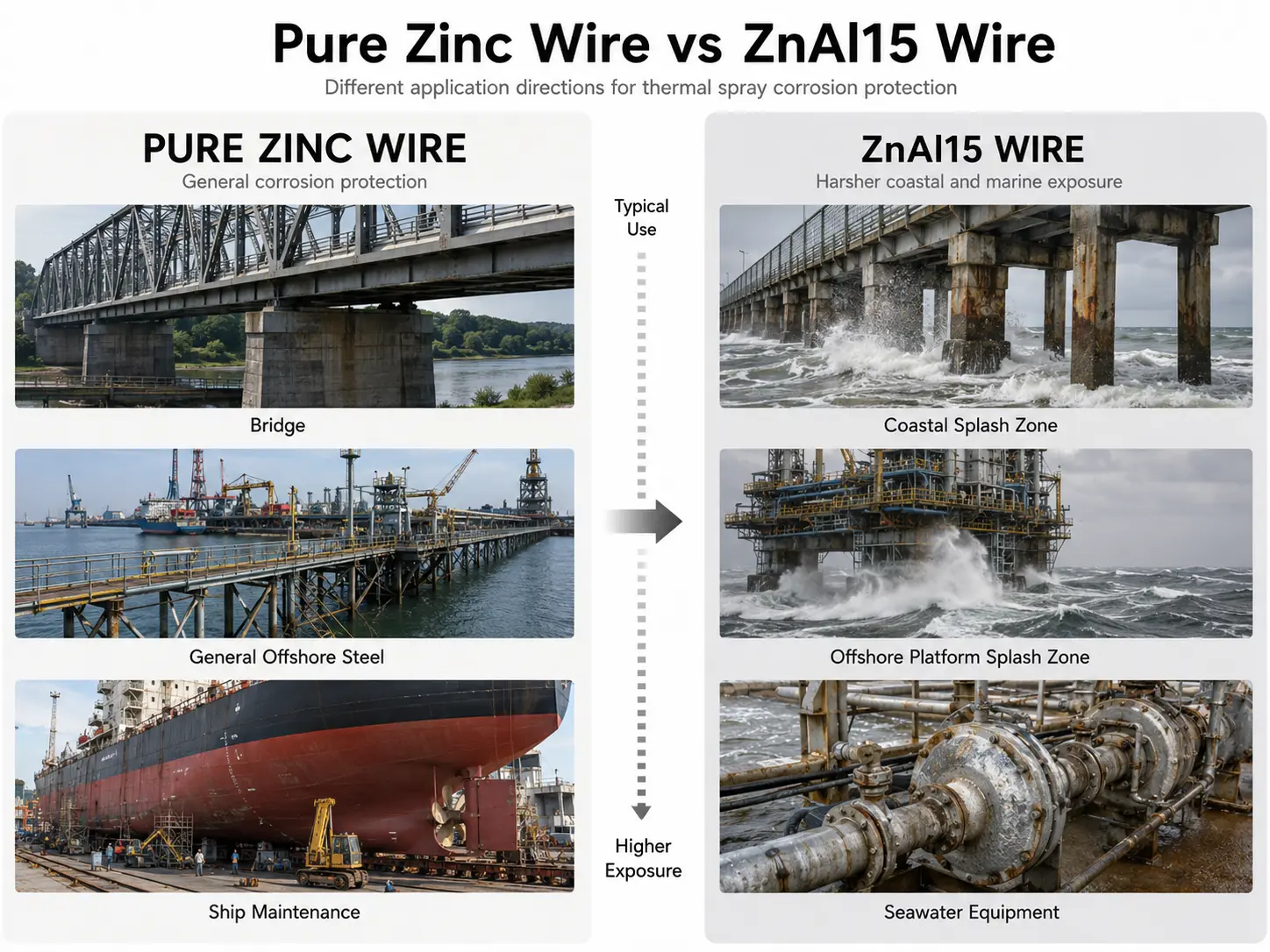
Direct Conclusion: Zinc Wire gives strong sacrificial cathodic protection and is suitable for bridge steel, general steel structures and cost-controlled anti-corrosion work. ZnAl15 wire is better for marine, offshore, port and high-humidity environments because the aluminum-rich surface film slows coating consumption in chloride exposure. <<viwe more
When you choose between pure zinc wire and ZnAl15 wire, do not compare material price alone. We suggest checking environment class, coating thickness, sealing system, expected service life, maintenance access and MTC composition before confirming the wire grade.
Composition Comparison - Pure Zinc vs ZnAl15
The fundamental difference is in the alloy composition and the protective mechanism:
| Property | Pure Zinc Wire 99.995% | ZnAl15 Wire 85/15 |
|---|---|---|
| Zinc content | 99.995% min | 84–86% |
| Aluminum content | - | 14–16% |
| Protection mechanism | Sacrificial galvanic protection | Sacrificial protection + barrier effect |
| Applicable standard | EN 1179 / ASTM B6 | EN 14616 / ISO 2063 |
| Melting point | ~420°C | ~450°C eutectic |
Coating Performance Comparison
When applied at equivalent thickness 200 μm, the performance difference becomes clear:
| Performance Metric | Pure Zinc 99.995% | ZnAl15 85/15 |
|---|---|---|
| Expected service life marine C5-M | 15–20 years | 25–30 years |
| Bond strength ISO 2063 | ≥ 25 MPa | ≥ 30 MPa |
| Maximum service temperature | 250°C | 350°C |
| Abrasion resistance | Moderate | Good |
| Coating density | ~6.6 g/cm³ | ~5.8 g/cm³ |
| Salt spray resistance ASTM B117 | ~2000 hr | ~4000 hr |
| Relative material cost | 1.0x baseline | 1.3–1.5x |
When to Choose Pure Zinc vs Zinc-Aluminum Alloy
Pure Zinc Wire Is Recommended For:
- Protecting steel in moderate atmospheric environments C2–C4 per ISO 12944
- Projects where cost per m² is the primary driver and 15–20 year coating life is acceptable
- Structures that will be regularly inspected and maintained
- Maximum cathodic sacrificial protection because pure zinc is a more active anode than ZnAl
- Applications where painting or sealing over the coating is planned, as pure zinc provides better paint adhesion
ZnAl15 Wire Is Recommended For:
- Protecting steel in severe marine or offshore environments C5-M / CX per ISO 12944
- Projects requiring minimum 25-year coating life without major maintenance
- Standalone coating systems without paint topcoats or with minimal sealing
- High abrasion or mechanical impact environments such as fender systems and ice-breaking ships
- Service temperatures above 250°C, including industrial stacks and exhaust structures

Zinc Wire for Bridge Cathodic Protection - Case Examples
Zinc thermal spray has been a proven method for protecting steel bridges since the 1970s. The coating serves a dual purpose: as a physical barrier and as a sacrificial anode that protects steel at coating defects and cut edges.
We have supplied zinc wire for several notable bridge projects, including:
- Rainbow Bridge Niagara Falls, Canada–USA - a major international bridge. Pure zinc wire 99.995% applied by arc spray at 200–250 μm coating thickness.
- Oresund Bridge Denmark–Sweden - combined road and rail bridge. ZnAl15 wire used for the marine splash zone with a 300 μm coating specification.
- Eastern span of the San Francisco–Oakland Bay Bridge USA - seismic retrofit project. Zinc thermal spray applied to critical structural steel components.
- Humber Bridge UK - suspension bridge. Zinc spray coating applied to steel chains and saddles during maintenance programs.
For bridge applications, we typically recommend 99.995% pure zinc wire with full EN 1179 Type 3.1 MTC documentation. The combination of thermal spray zinc plus a sealer topcoat provides the most cost-effective long-term protection for bridge steel.
Offshore Marine - Why ZnAl15 Is Often Preferred
In offshore environments, including splash zone, tidal zone and deck areas, the corrosion rate is significantly higher. The North Sea, Gulf of Mexico and Southeast Asian offshore fields are classified C5-M or CX per ISO 12944, which are among the most severe corrosion categories.
In these conditions, ZnAl15 offers measurable advantages:
Long-Term Cost Comparison per m², 30-year life
| Cost Factor | Pure Zinc 200 μm | ZnAl15 200 μm |
|---|---|---|
| Material cost | 1.0x | 1.4x |
| Application cost | 1.0x | 1.0x |
| Coating life | 15–20 years | 25–30 years |
| Recoat cycles 30 yr | 1–2 recoats needed | 0–1 recoat needed |
| Total 30-year cost | 2.0x–2.5x | 1.0x–1.4x |
The initial material premium for ZnAl15 is offset by fewer maintenance cycles over the structure's life. For offshore platforms where access for recoating is expensive, the total lifecycle cost of ZnAl15 is often lower.
ISO 2063 Compliance and Coating Standards
Both pure zinc and ZnAl15 thermal spray coatings are covered by ISO 2063, Thermal spraying - Zinc, aluminium and their alloys. Key requirements include:
- Minimum bond strength: 25 MPa for zinc, 30 MPa for ZnAl15
- Minimum coating thickness: 80–100 μm for atmospheric use, 150–200 μm for marine use
- Coating thickness variation: ≤ 30% individual readings from specified value
- MTC required for each batch showing chemical composition per applicable standard
Both our pure zinc wire and ZnAl15 wire are tested in-house to ISO 2063 requirements. We provide Type 3.1 MTC per EN 10204 with every shipment, including chemical analysis and mechanical test data.
Frequently Asked Questions
Q:What is the difference between zinc wire and ZnAl wire for thermal spray?
A:Pure zinc wire 99.995% Zn provides strong sacrificial cathodic protection and is used for most steel corrosion protection work. ZnAl15 wire, usually 85% Zn and 15% Al, gives higher bond strength, better abrasion resistance and longer service life in aggressive marine environments, but the material cost is higher.
Q:Is zinc wire suitable for bridge cathodic protection?
A:Yes. Zinc thermal spray has been used for bridge cathodic protection since the 1970s. It provides both a physical barrier and sacrificial anode protection to steel bridge structures, especially in coastal and de-icing salt environments. Many bridge projects specify 99.995% zinc wire per EN 1179.
Q:How long does a thermal spray zinc coating last in marine environments?
A:Pure zinc thermal spray coatings with 150–300 μm thickness typically provide 15–20 years of protection in moderate marine environments. ZnAl15 coatings can extend this to about 25–30 years. Actual service life depends on coating thickness, application quality and environmental severity.
Q:What is ZnAl15 wire used for?
A:ZnAl15 wire, usually 85% zinc and 15% aluminum, is used for high-performance corrosion protection in offshore platforms, ship hulls, coastal bridges and industrial structures exposed to severe marine environments. It gives higher bond strength, better temperature tolerance and longer service life compared with pure zinc coating.
Need help selecting the right thermal spray wire?
We supply both 99.995% pure zinc wire and ZnAl15 alloy wire with full MTC documentation per EN 10204 Type 3.1. Our technical team can provide coating design recommendations, sample spools for trial and lifecycle cost analysis for your project.
Contact us with your project specifications, including environment class, design life and coating thickness, and we will respond with matched product recommendations and pricing.
- Zhenan New Materials, Anyang, Henan, China | 30+ years in metallurgical material supply | In-house testing lab | Global export to 20+ countries
Request Wire Selection & Quote