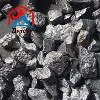
Choosing the right grade of silicon carbide is an important decision for industrial users in metallurgy, steelmaking, and foundry operations. Among the available options, 88% and 90% silicon carbide are the most widely used due to their practical performance, availability, and suitability for large-scale industrial applications.
Although the difference in purity between these two grades appears relatively small, it can influence reaction behavior, consistency, and overall production results. Understanding which grade to choose requires looking beyond purity alone and considering application requirements, process tolerance, and cost efficiency.
The primary difference between these two grades lies in SiC content and impurity levels.
88% silicon carbide contains a slightly higher level of impurities, while 90% silicon carbide offers higher purity and more controlled chemical composition.
This difference affects reaction consistency and stability during high-temperature processes. While both grades share the same fundamental crystal structure and core properties, the 90% grade generally provides more predictable performance in applications with stricter quality requirements.
88% silicon carbide is often the preferred option for large-scale, cost-sensitive industrial operations. It delivers reliable performance in steelmaking and foundry applications where process tolerance is relatively broad.
This grade is widely used as a deoxidizer and carbon-silicon additive in standard steel production and cast iron melting. Its cost-performance balance makes it suitable for high-volume consumption without compromising overall production stability.
90% silicon carbide is better suited for applications that require higher consistency and tighter process control. Its higher purity results in more stable reaction behavior and improved predictability during melting and alloying processes.
Steelmakers and foundries producing higher-grade products or operating under stricter quality standards often choose the 90% grade to reduce variability, improve melt cleanliness, and enhance overall product quality.
Both grades improve metallurgical and foundry performance by acting as deoxidizers and sources of silicon and carbon. However, their performance consistency differs.
88% silicon carbide performs well in standard applications and supports stable production at lower cost. 90% silicon carbide offers improved consistency, making it more suitable for applications where repeatability and reduced scrap rates are critical.
In practice, many industrial users apply both grades strategically across different production lines.
The choice between 88% and 90% silicon carbide should be based on application requirements, quality targets, and economic considerations.
Key factors include:
- Required level of chemical control
- Production scale and consumption volume
- Tolerance for process variation
- Cost sensitivity and long-term efficiency
Purity alone should not be the only deciding factor; supplier reliability and product consistency are equally important.

Conclusion
There is no single "best" choice between 88% and 90% silicon carbide for all applications. 88% silicon carbide is ideal for large-scale, cost-sensitive operations, while 90% silicon carbide is better suited for applications requiring higher consistency and tighter quality control.
Understanding your specific production requirements and working with a reliable supplier are key to making the right decision. By selecting the appropriate grade and ensuring consistent supply, industrial users can fully realize the performance and economic advantages of silicon carbide in modern metallurgical and foundry operations.
Our company's advantages in supplying silicon carbide
As an experienced supplier in the metallurgical raw materials industry, we provide both 88% and 90% silicon carbide tailored to real industrial needs.
With long-term experience in production and processing, we operate integrated smelting, crushing, and screening systems. This allows us to control raw materials, furnace parameters, impurity levels, and particle size distribution, ensuring stable reaction behavior and consistent performance across batches.
Unlike suppliers that rely mainly on spot trading, our production-based supply model enables us to offer stable long-term supply, flexible specifications, and consistent quality for both grades.
We also place strong emphasis on packaging and transportation, which directly affect material performance. Our silicon carbide products are packed in moisture-resistant, durable packaging such as 25 kg bags or 1 MT jumbo bags, protecting product quality during storage and long-distance transportation. With extensive export experience, we ensure reliable delivery to customers worldwide.
By combining controlled production, consistent quality, and professional export service, we help customers reduce procurement risks and maintain stable production performance.