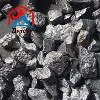
SiC silicon carbide is a compound semiconductor material composed of carbon and silicon elements. It is one of the ideal materials for making high-temperature, high-frequency, high-power, and high-voltage devices.

The core advantages of silicon carbide raw materials are reflected in:
(1) High voltage resistance: lower impedance, wider bandgap, can withstand greater current and voltage, leading to smaller size product design and higher efficiency;
(2) High frequency resistance: There is no current tailing phenomenon in SiC devices during the turn-off process, which can effectively increase the switching speed of the component (about 3-10 times that of Si), and is suitable for higher frequencies and faster switching speeds. ;
(3) High temperature resistance: SiC has higher thermal conductivity than silicon and can work at higher temperatures.

Compared with traditional silicon material (Si), the band gap of silicon carbide (SiC) is 3 times that of silicon; the thermal conductivity is 4-5 times that of silicon; the breakdown voltage is 8-10 times that of silicon; and the electron saturation drift rate 2-3 times that of silicon.